 English▼



- Battery Manufacturing Equipment
- Battery Laboratory Assembly Equipment
- Battery Pack Assembly Equipment
- Sodium Ion Battery Manufacturing Equipment
- Solid State Cell Production Line
- Dry Electrode Assembly Equipment
- Supercapacitor Assembly Equipment
- Perovskite Solar Cell Lab Equipment
- Li ion Battery Materials
- Ni / Al / Cu Metal Foam
- Customized Electrode
- Cathode Active Materials
- Anode Active Materials
- Coin Cell Parts
- Lithium Chip
- Cylindrical Cell Parts
- Battery Current Collectors
- Battery Conductive Materials
- Electrolyte
- Battery Binder
- Separator and Tape
- Aluminum Laminate Film
- Nickel Strip/Foil
- Battery Tabs
- Graphene Materials
- Cu / Al / Ni / Stainless steel Foil
- Battery Laboratory Equipment
- Li ion Battery Tester
- Battery Safety Tester
- Material Characterization Tester
- Rolling Press Machine
- Electrode Mixer
- Coin Cell Crimping Machine
- Coin Cell Electrode Disc Punching
- Pouch Cell Sealing Machine
- Pouch Cell Stacking Machine
- Pouch Cell Forming Machine
- Pouch Cell Ultrasonic Welder
- Pouch Cell Electrode Die Cutter
- Cylinder Cell Sealing Machine
- Cylinder Cell Grooving Machine
- Electrode Slitting Machine
- Cylinder Cell Winding Machine
- Cylinder Cell Spot Welding Machine
- Electrolyte Filling
- Type Test Cell
- Other Battery Making Machine
- NMP Solvent Treatment System
- Vacuum Glove Box
- Coating Machine
- Lab Furnaces
- Ball Mill
- Laboratory Press
- Laboratory Equipment
- Press Equipment
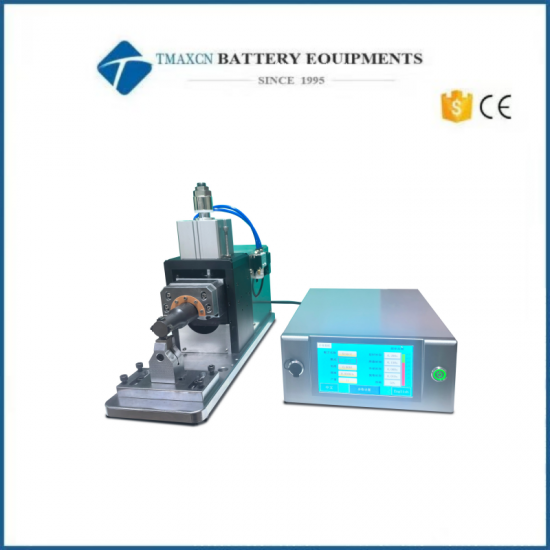
3000W 20K Ultrasonic Welding Machine Intelligent Digital Type
Model Number:
TMAX-XC-20KInput Power:
3000WCompliance:
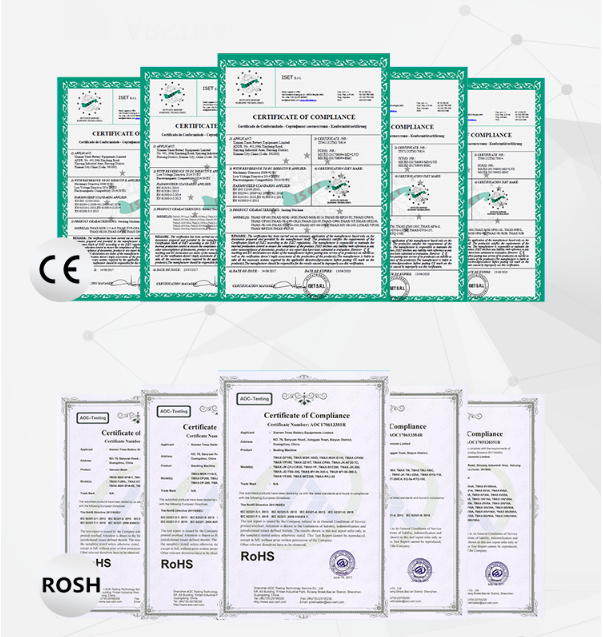
CE certificateWarranty:
Two Year Limited Warranty With Lifetime SupportPayment:
T/T, Credit Card, Paypal, LC, Western UnionDelivery Time:
3 Days
3000W 20K Ultrasonic Welding Machine Intelligent Digital Type
1. Working Principle and Core Features
1.1 Working Principle of Ultrasonic Metal Welding Machine
This device is a half-wave ultrasonic metal welding machine that employs solid-phase welding technology, achieving complete metal-free melting throughout the process. It realizes molecular-level penetration bonding of metals through the synergistic interaction of acoustic systems and mechanical structures.
|
Process Phase |
function declaration |
|
signal conversion |
The transducer receives high-power ultrasonic oscillation signals and converts electrical energy into mechanical vibrations of the same frequency through the piezoelectric effect. |
|
energy amplification |
The vibrational energy is precisely amplified by the amplifier and coupled to the load, ensuring lossless and accurate transmission to the welding head. |
|
heat generation by friction |
The welding head applies mechanical vibration energy to the interface of the metal workpiece to be welded. Under the combined effects of high-frequency elastic vibration and static pressure, frictional heat is generated in the workpiece. |
|
Molecular welding |
Thermal friction activates metal lattice particles, which undergo plastic flow under pressure to achieve stable welding. |
1.2 Core Components
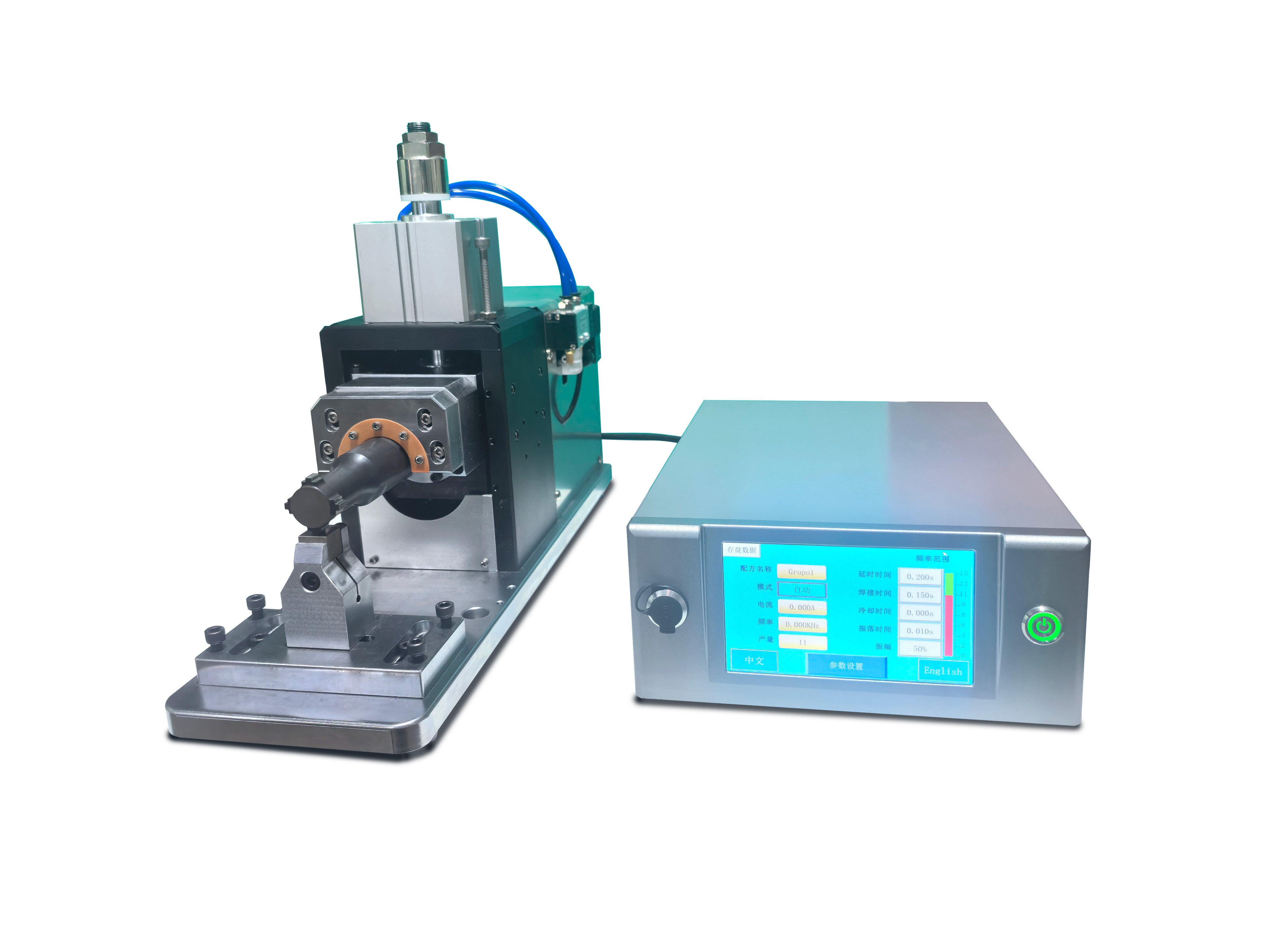
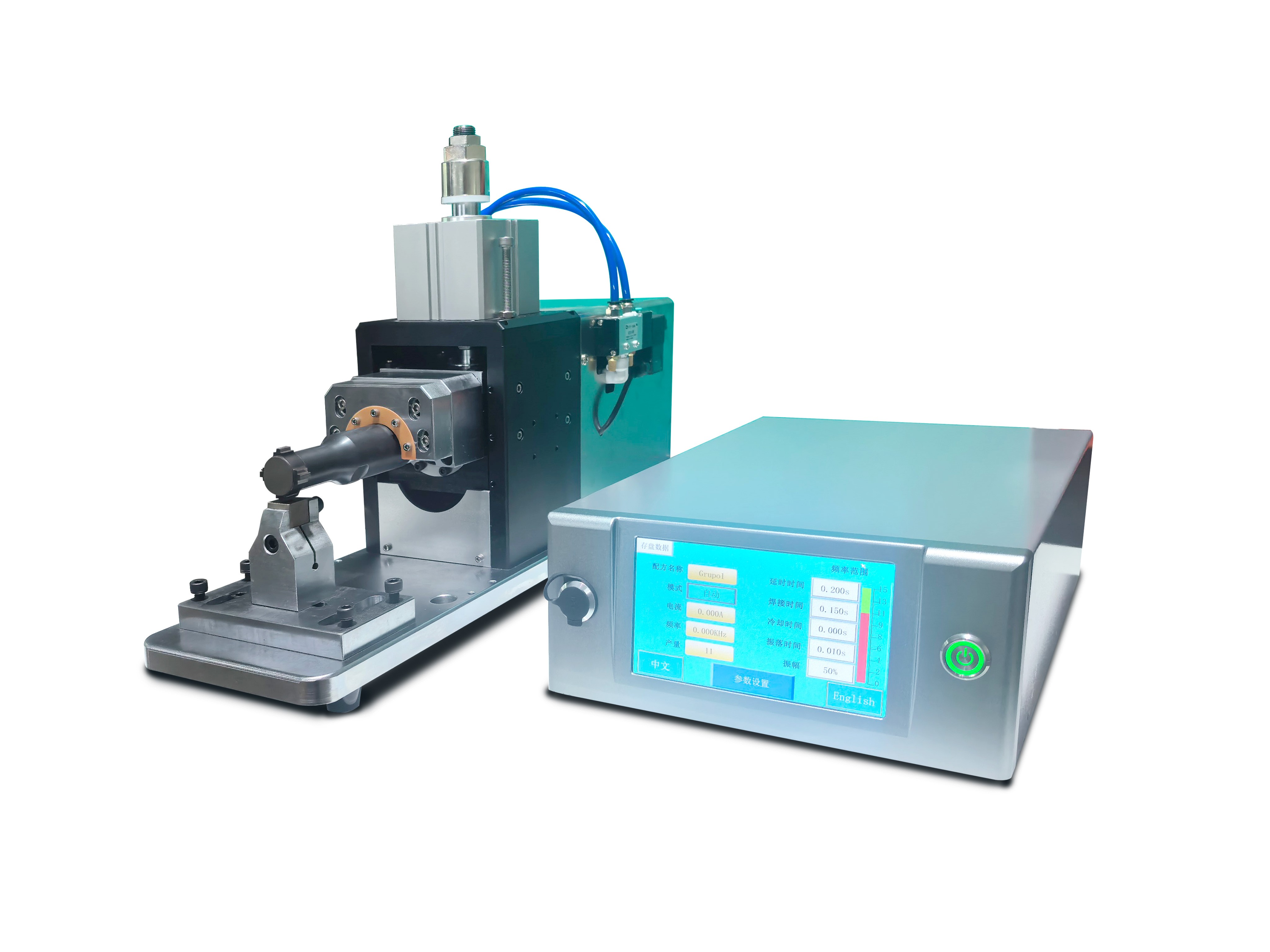
The ultrasonic welding system consists of an ultrasonic generator, transducer, mold, pneumatic components, and frame. The functional analysis of each core component is as follows:
|
Core Components |
Core Features |
|
ultrasonic generator |
The frequency conversion core device converts power frequency current into ultrasonic frequency oscillation current, featuring intelligent frequency tracking capability with a response time of ≤1ms. |
|
energy conversion device |
Energy conversion core, with electrical-to-mechanical energy conversion efficiency ≥92% (industry-leading) |
|
amplifier |
Amplitude amplification + dedicated load coupling components for precise vibration amplitude amplification |
|
weldment |
The vibration energy and static pressure work together to complete the solid-phase welding process. |
1.3 Core Features of the Equipment
This device integrates two core technologies: intelligent resonance tracking technology and high-efficiency energy conversion system, representing a new generation of highly adaptable ultrasonic welding equipment. It is characterized by high efficiency, superior quality, energy conservation, and precision, specifically designed for welding thin sheets of non-ferrous metals such as copper, aluminum, nickel, and silver.
1. Equipped with an intelligent parameter matching system, it automatically determines the optimal ultrasonic frequency and power based on the material, thickness, and structure of the weld piece, enabling customized welding.
2. The entire process features no fusion welding and no heat-affected zone, resulting in robust weld points with minimal internal resistance, making it suitable for welding applications requiring high precision and high conductivity.
3. Pure mechanical solid-phase bonding process with no current flowing through the welded components and no welding arc generation, fundamentally avoiding issues such as uneven heat conduction and resistivity interference;
4. Energy consumption is only 1/3 to 1/5 of that in traditional arc welding and resistance welding, aligning with green production principles.
2. Technical Parameters
2.1 20KHz (3000W) parameters
|
Component |
Qualification |
Specific Parameters |
|
Energy Conversion Device |
frequency |
20KHz±0.15KHz |
|
|
power |
3000W (peak) |
|
Welding Control |
Pressure adjustment range |
0 MPa to 1 MPa, adjustable |
|
|
Time adjustment range |
0–60 seconds, adjustable |
|
|
Single welding time |
≤0.5S |
|
|
Amplitude adjustment range |
10%~100% |
|
|
Quality control function |
System shutdown due to frequency, power, energy, or amplitude exceeding limits |
2.3 Circuit Structure Advantages
The device adopts an intelligent switching power supply architecture with Class D high-efficiency amplification circuitry and a dedicated power factor correction module (power factor ≥0.95), offering the following advantages over traditional circuit designs:
1. Lower energy consumption: With high power factor and superior energy conversion efficiency, the overall operational energy consumption of the equipment is significantly reduced.
2. Enhanced stability: The circuit delivers precise output power with minimal fluctuations, ensuring consistent quality across batch-welded joints.
3. Superior anti-interference capability: Adapts to complex industrial power environments and effectively resists voltage and frequency fluctuation interference from the power grid.
3. Customer Welding Process Requirements and Product Compatibility Specifications
This equipment is specifically designed for new energy cell welding processes, compatible with positive and negative electrode welding for wound/welded stack-type cells. The detailed process requirements and product specifications are as follows:
|
Project |
Detailed Requirements |
Specification Parameters |
|
Substrate Compatibility |
Core Specifications |
20KHz(3000W) |
|
Anode Welding |
Matrix material/thickness |
Copper foil / 4-8μm |
|
|
Connector material/thickness |
Nickel strip / 0.06-0.3 mm |
|
Positive Electrode Welding |
Matrix material/thickness |
Aluminum foil / 6-25μm |
|
|
Connector material/thickness |
Aluminum / 0.06-0.3mm |
|
Cell Adaptation |
Cell structure/layers |
Wound or laminated / 10-40 layers |
|
|
Soldering specifications |
4mm×20mm (customizable) |
|
Welding Seat For Welding Head |
Welding material/life |
Imported high-speed steel / Negative electrode> 300,000 cycles / Positive electrode> 500,000 cycles |
|
|
Material/Life of welding seat |
High-speed steel / Negative electrode> 300,000 cycles / Positive electrode> 500,000 cycles |
4. Advantages of Equipment and Benefits of Welding Products
4.1 Core Advantages of Equipment
1. Wide material compatibility range: Capable of efficient welding of ultra-thin metal sheets (0.05mm) to thick plates (1.5mm), compatible with dissimilar metal welding processes such as copper-aluminum composite and steel-aluminum butt welding.
2. High cost-effectiveness in production economics: Fast welding speed, low operational threshold, low power consumption during equipment operation, and core components requiring minimal frequent maintenance;
3. Enhanced operational convenience: Equipped with intelligent ultrasonic power sources and high-precision transducer systems, featuring visualized touchscreen settings for operational parameters;
4. More user-friendly operating conditions: Requires only a stable gas supply at 0.6–1 MPa and an independent power supply of 220V/20A or higher, with no need for special workshop modifications.
5. Enhanced stability with multiple protections: Equipped with multi-layer protection systems including voltage protection, overload protection, overcurrent protection, and welding overload feedback.
4.2 Core Advantages of Welded Products
|
Advantages Category |
Define |
|
High-Efficiency Mass Production |
Complete a single welding operation within 0.01-1 seconds, achieving over 30% improvement in production efficiency. |
|
Excellent Weldability |
The temperature of the welded piece shall not exceed the annealing temperature, and the welding strength shall be increased by 20% to 50%. |
|
Conductive Excellence |
The resistance coefficient of the solder joint approaches zero, meeting the requirements for high-precision electronic components. |
|
Clean Without Pretreatment |
The ultrasonic device is equipped with built-in surface cleaning functionality, eliminating the need for additional processing. |
|
Environmentally Friendly And Additive-Free |
No soldering or solder oil required, with no sparks or smoke/dust generated |
|
Durable |
The service life of the welding head is more than twice that of a conventional welding head. |
|
Regular Appearance |
The weld spot shows no oxidation marks and has an aesthetically pleasing surface, with no welding slag or incomplete welding. |
|
High Pass Rate |
Welding pass rate ≥99.5% (under identical material conditions) |




 David@battery-equipments.com

