 English▼



- Battery Manufacturing Equipment
- Battery Laboratory Assembly Equipment
- Battery Pack Assembly Equipment
- Sodium Ion Battery Manufacturing Equipment
- Solid State Cell Production Line
- Dry Electrode Assembly Equipment
- Supercapacitor Assembly Equipment
- Perovskite Solar Cell Lab Equipment
- Li ion Battery Materials
- Ni / Al / Cu Metal Foam
- Customized Electrode
- Cathode Active Materials
- Anode Active Materials
- Coin Cell Parts
- Lithium Chip
- Cylindrical Cell Parts
- Battery Current Collectors
- Battery Conductive Materials
- Electrolyte
- Battery Binder
- Separator and Tape
- Aluminum Laminate Film
- Nickel Strip/Foil
- Battery Tabs
- Graphene Materials
- Cu / Al / Ni / Stainless steel Foil
- Battery Laboratory Equipment
- Li ion Battery Tester
- Battery Safety Tester
- Material Characterization Tester
- Rolling Press Machine
- Electrode Mixer
- Coin Cell Crimping Machine
- Coin Cell Electrode Disc Punching
- Pouch Cell Sealing Machine
- Pouch Cell Stacking Machine
- Pouch Cell Forming Machine
- Pouch Cell Ultrasonic Welder
- Pouch Cell Electrode Die Cutter
- Cylinder Cell Sealing Machine
- Cylinder Cell Grooving Machine
- Electrode Slitting Machine
- Cylinder Cell Winding Machine
- Cylinder Cell Spot Welding Machine
- Electrolyte Filling
- Type Test Cell
- Other Battery Making Machine
- NMP Solvent Treatment System
- Vacuum Glove Box
- Coating Machine
- Lab Furnaces
- Ball Mill
- Laboratory Press
- Laboratory Equipment
- Press Equipment
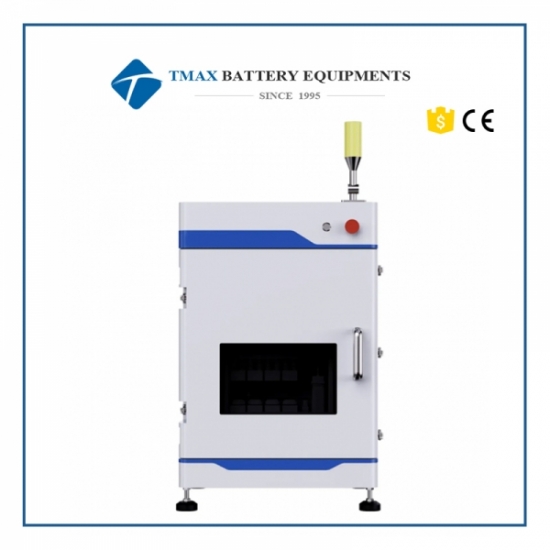
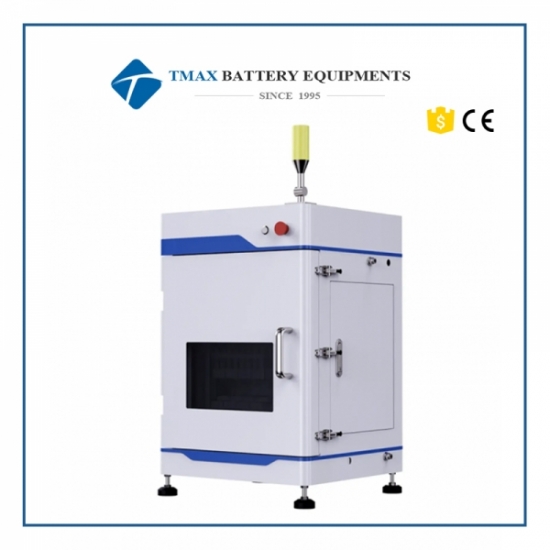
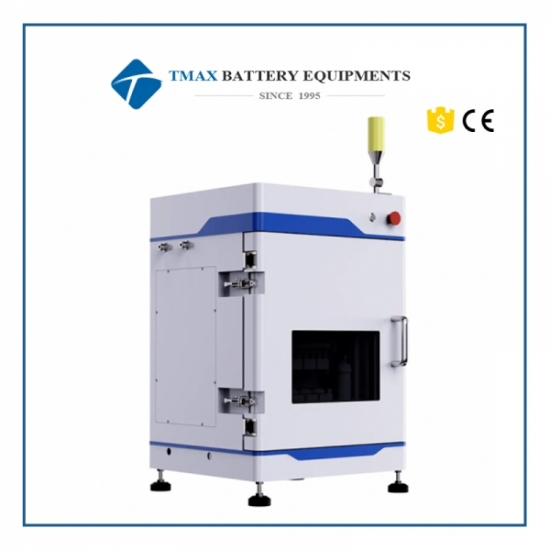
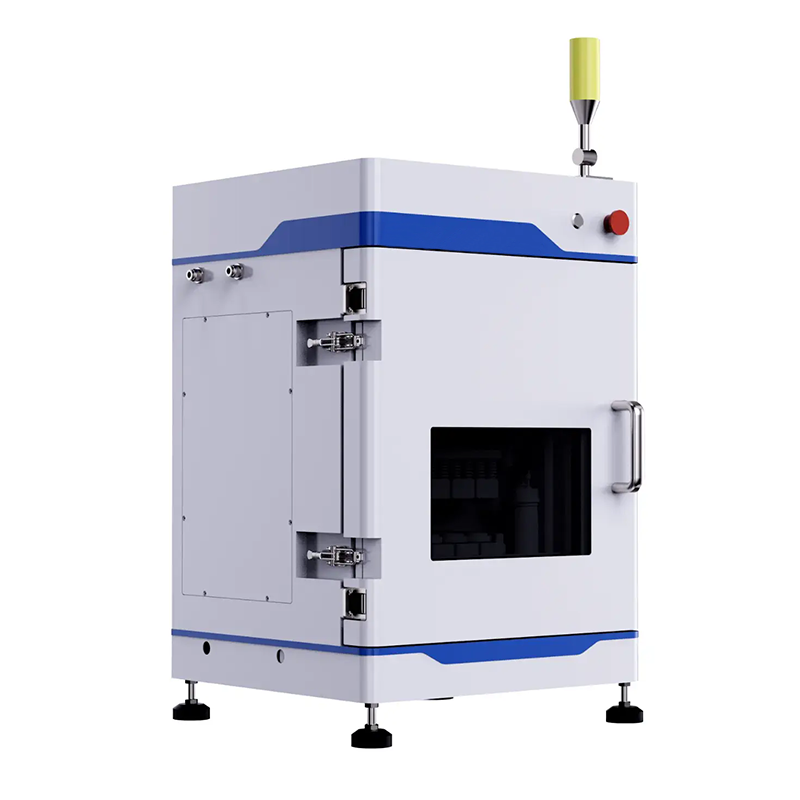
Electrode Tortuosity Tester & Separator Ion Conductivity Tester
Model Number:
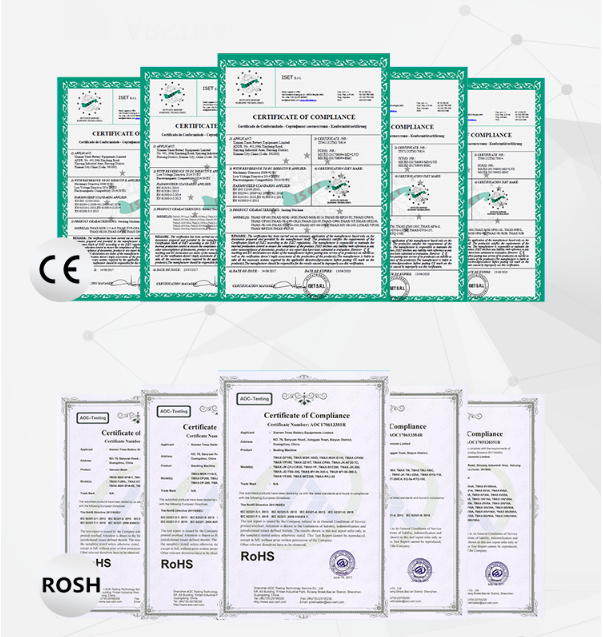
TMAX-EICCompliance:
CE certificateWarranty:
Two Year Limited Warranty With Lifetime SupportPlace of Origin:
ChinaPayment:
T/T, Credit Card, Paypal, LC, Western UnionDelivery Time:
3 Days
Electrode Tortuosity Tester & Separator Ion Conductivity Tester
Characteristic
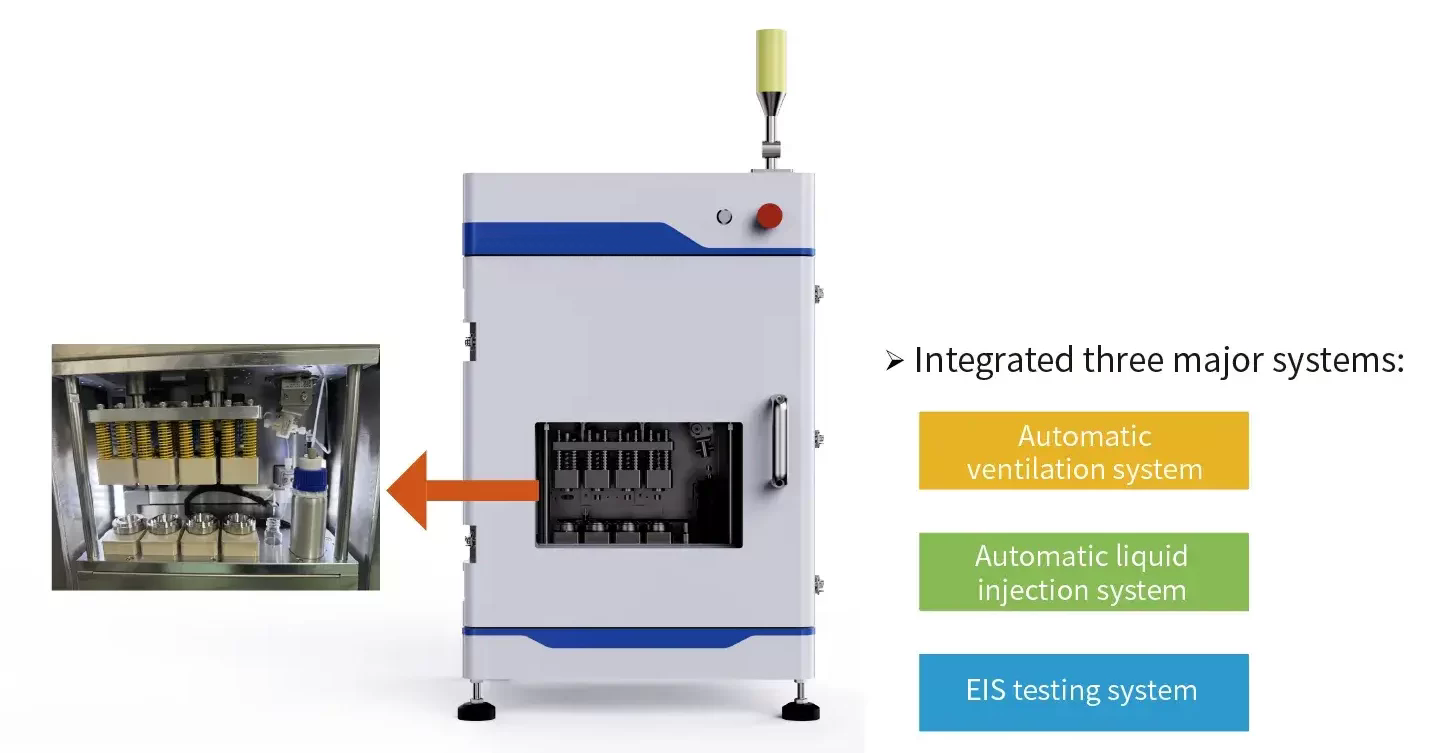
1. Calculate the tortuosity of the electrode by testing the EIS of the battery with symmetrical electrodes.
2. Simple assembly, automated testing and analysis, simplified operating steps, and improved testing efficiency.
3. Four-channel synchronous test.
4. McMullin Number and Tortuosity Measurement
Applications
1. Electrode tortuosity test
2. Separator ion conductivity test
Description
1. Creative Solution One
1.1 Creative Solution:
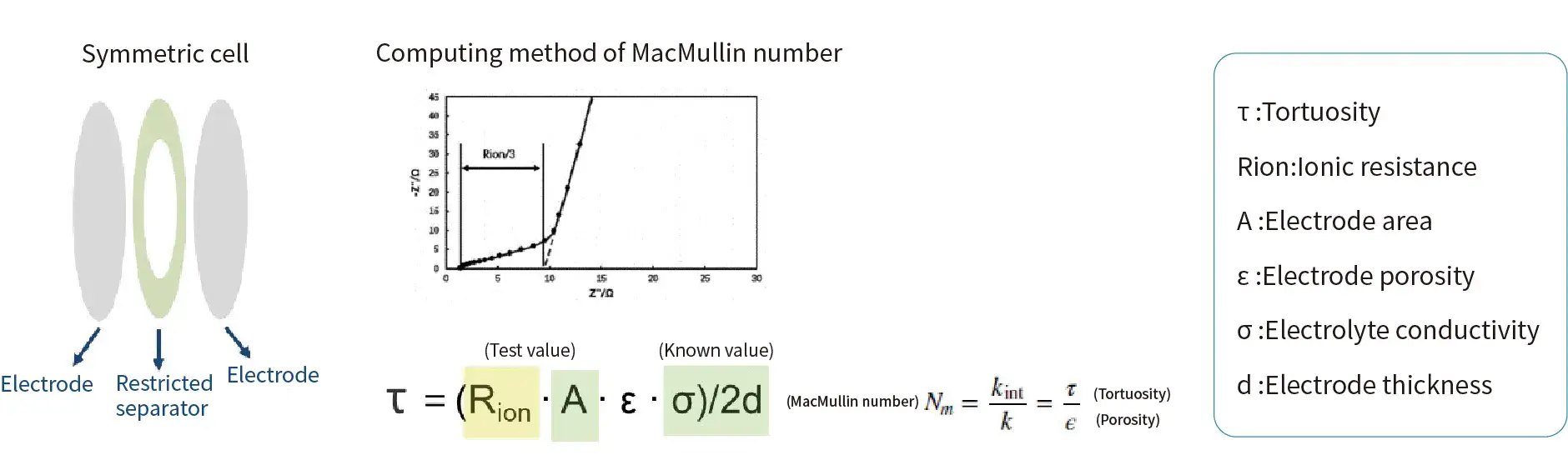
1) Calculate the MacMullin number of the electrode by testing the EIS of the symmetric cell.
2) Simplify assembly, automate testing and analysis processes, streamline operation steps,and enhance testing efficiency.
3) Synchronous testing across four channels.
1.2 Testing Principle:
1) Assemble symmetric batteries and conduct EIS testing.
2) As shown in the figure below, low-frequency segments of the EIS spectrum separately. The diference between the intersection of the fitting curves and the X-axis multiplied by 3 is the ionic resistance of the electrode coating.
3) Using the following formula, the MacMulin number can be calculated, This allows for the pre-evaluation of the electrochemica performance of the electrode after it is assembled into a cell. Therefore, characterization and compaison ofthe ionic conductivity of the electrode coating are particularly important.
Application Cases
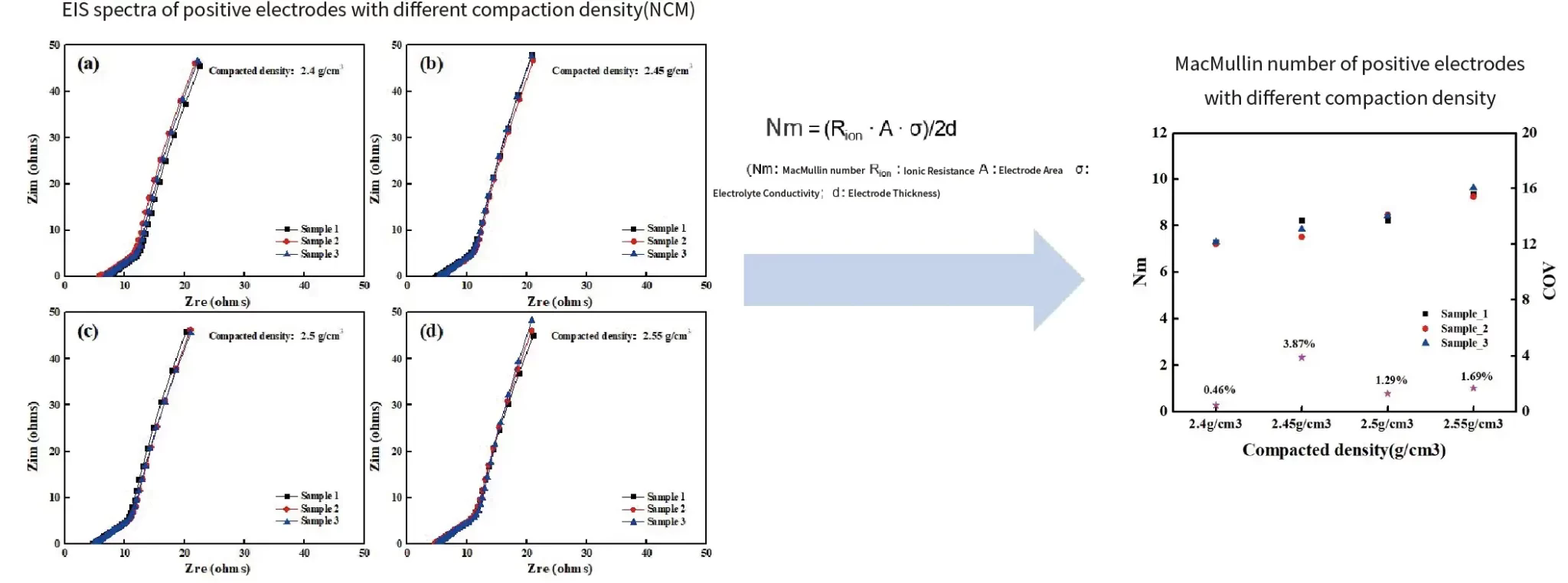
Case 1. Different compaction density of cathode electrodes
Summary:
1) The consistency of ElS testing for symmetric battery of electrodes is generally good.
2) Within a certain range of compaction density, as the compaction increases, the ionic resistance/MacMullin numb also increases.
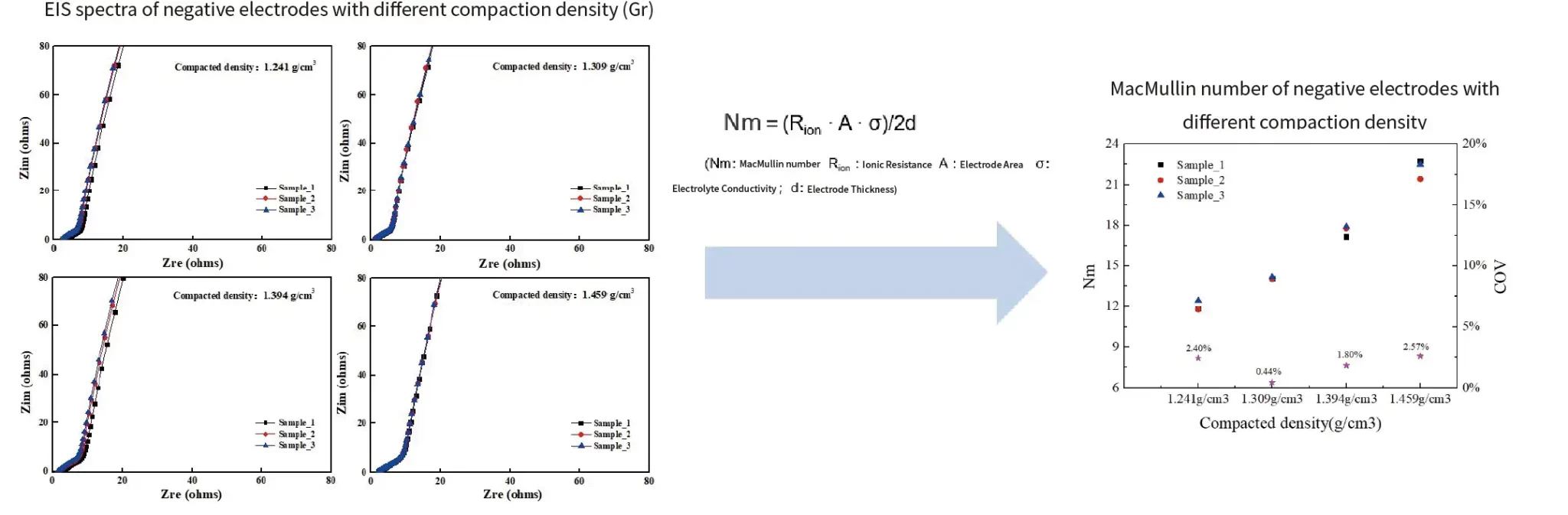
Case 2. Different compaction density of anode electrodes
Summary:
1) The consistency of ElS testing for symmetric battery of electrodes is generally good.
2) Within a certain range of compaction density, as the compaction increases, the ionic resistance/MacMullin numb also increases.
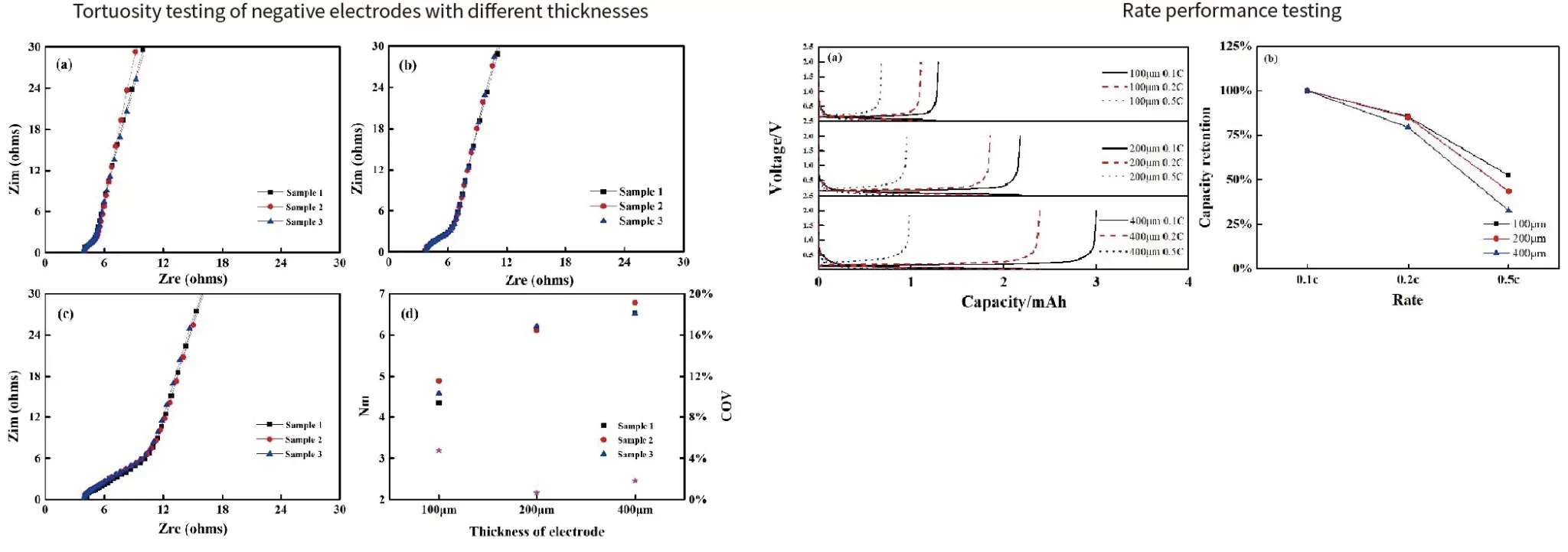
Case 3. The correlation between electrode tortuosity and electrochemical performance(Gr anode electrodes of different thicknesses)
Summary:
1) As the thickness of the electrode increases, its tortuosity also increases, However, the rate performance of the battery decreases with increasing thickness.
2) This indicates that the rate performance of the battery decreases with increasing tortuosity. There is a certain correlation between electrode tortuosity and rate performance of battery.
Case 4. Different coated separators(Ionic conductivity testing of four different coated separators)
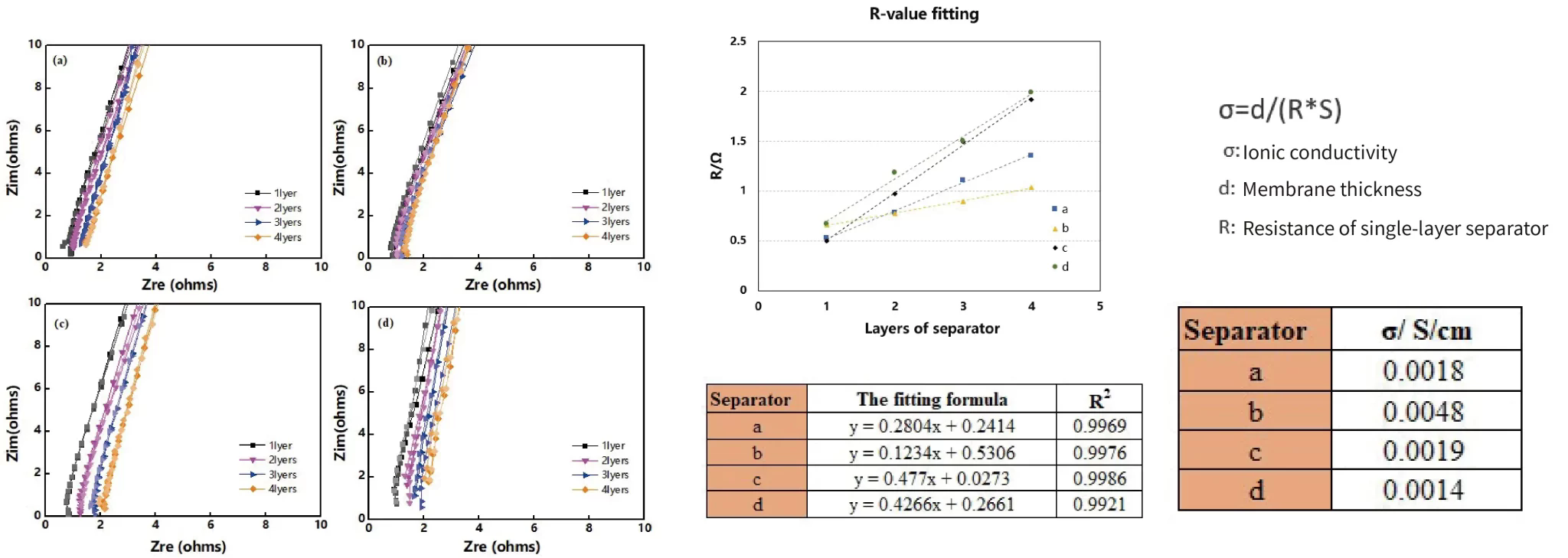
Summary:
1) Test the EIS of 1-4 layers of separators to obtain R1, R2, R3, R4.
2) Plot a curve with the number of separator layers as the x-axis and separator resistance as the y-axis. Calculate the slope and linear fitting degree of the curve, with the linear fitting degree ≥0.99.
3) Calculate the separator ionic conductivity according to the formula.
Case 5. Correlation between the tortuosity of the electrode and its electrochemical performance in different electrolytes
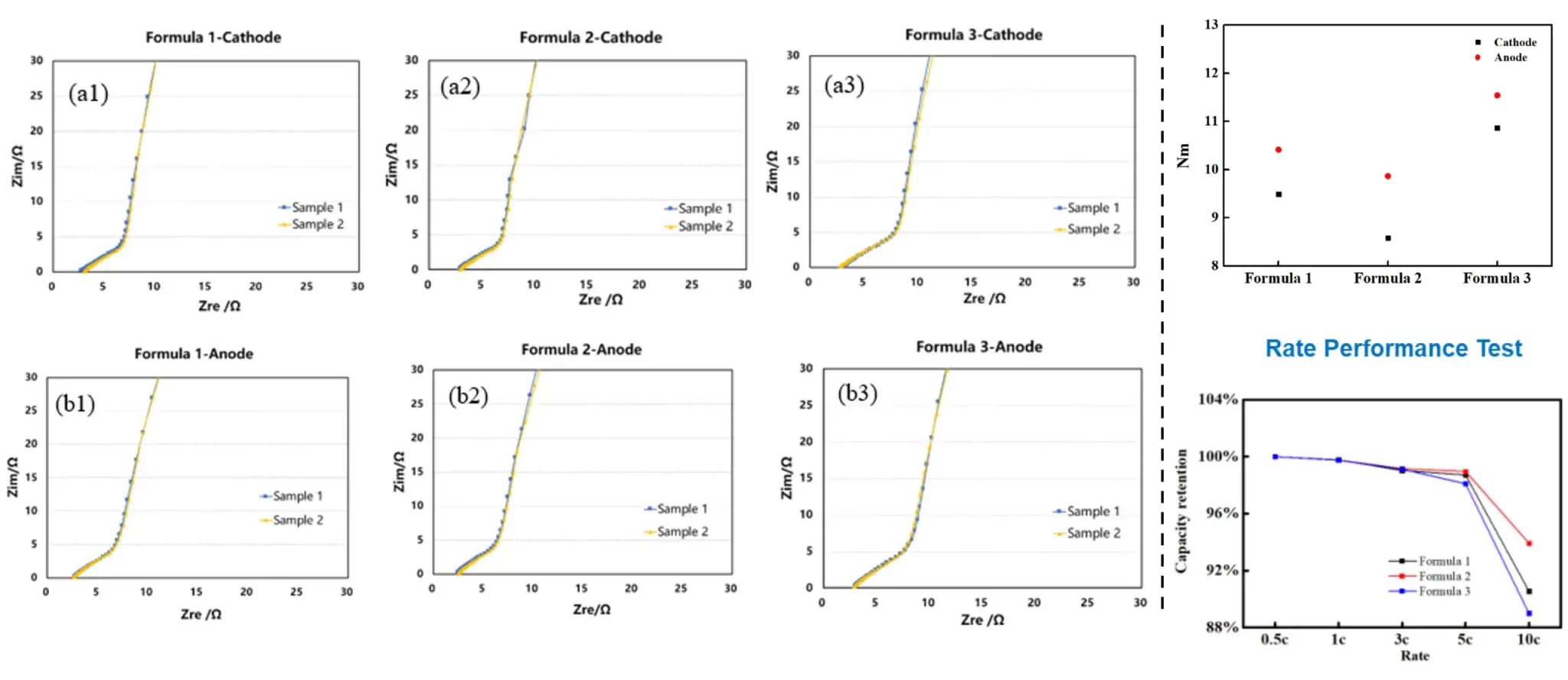
Summary:
1) MacMullin number Ranking: Formula 2< Formula 1< Formula 3
2) Capacity retenuation Ranking(10C): Formula 2(93.92%) > Formula 1(90.55%)> Formula 3(89%)
Case 6. Tortuosity & Wettability of LFP Cathodes with Different Compaction Densities
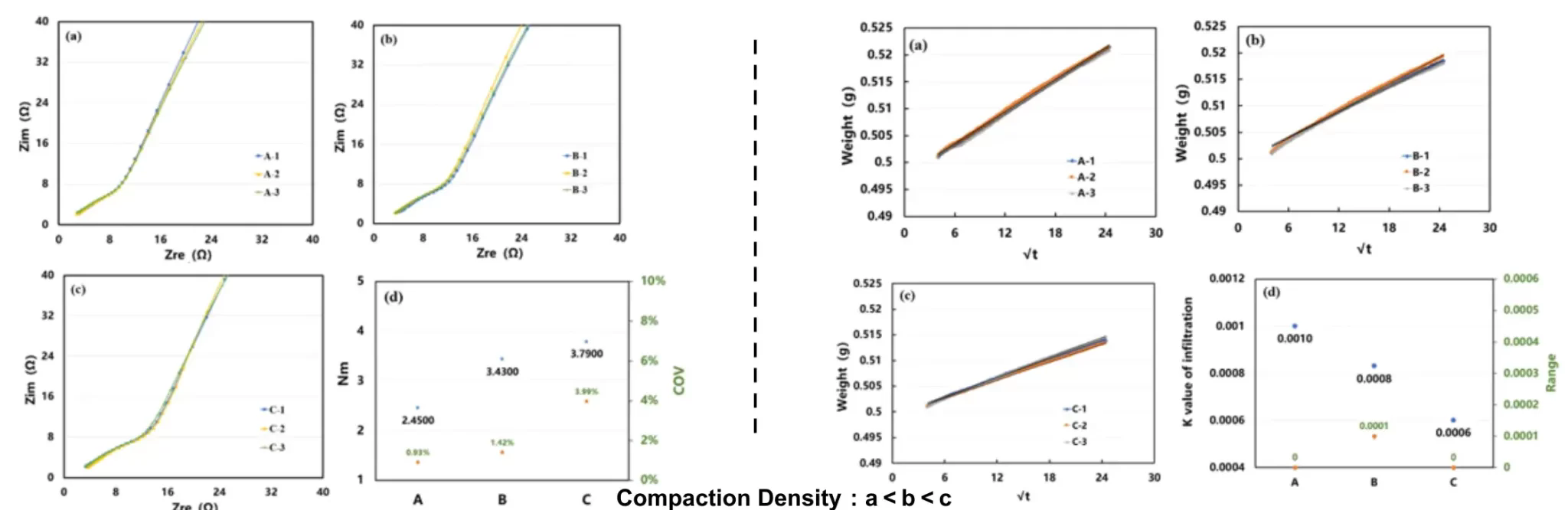
Summary:
1) Electrode with poorer wettability exhibit greater tortuosity.
2) As compaction density increases, electrolyte absorption declines, hindering permeation and lithium-ion migration, which elevates ion transport resistance and electrode tortuosity.
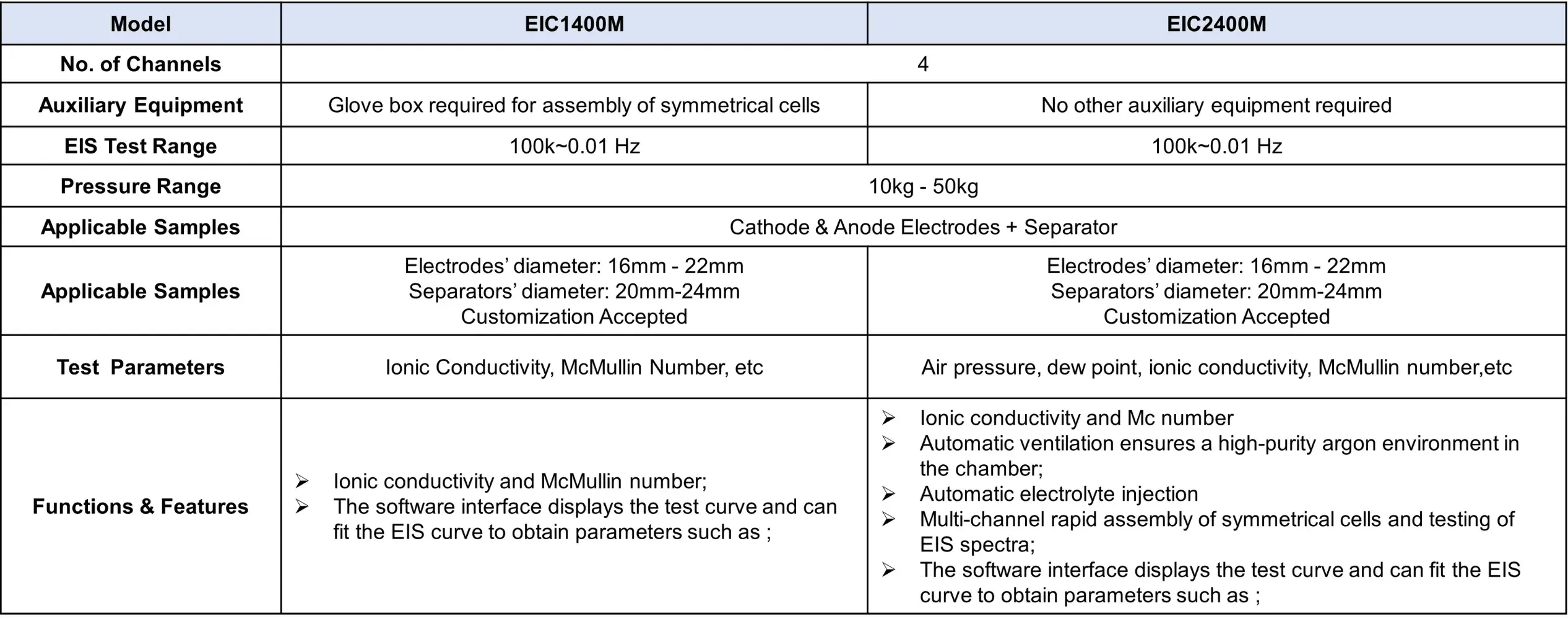
Specifications





 David@battery-equipments.com

