 English▼



- Battery Manufacturing Equipment
- Battery Laboratory Assembly Equipment
- Battery Pack Assembly Equipment
- Sodium Ion Battery Manufacturing Equipment
- Solid State Cell Production Line
- Dry Electrode Assembly Equipment
- Supercapacitor Assembly Equipment
- Perovskite Solar Cell Lab Equipment
- Li ion Battery Materials
- Ni / Al / Cu Metal Foam
- Customized Electrode
- Cathode Active Materials
- Anode Active Materials
- Coin Cell Parts
- Lithium Chip
- Cylindrical Cell Parts
- Battery Current Collectors
- Battery Conductive Materials
- Electrolyte
- Battery Binder
- Separator and Tape
- Aluminum Laminate Film
- Nickel Strip/Foil
- Battery Tabs
- Graphene Materials
- Cu / Al / Ni / Stainless steel Foil
- Battery Laboratory Equipment
- Li ion Battery Tester
- Battery Safety Tester
- Material Characterization Tester
- Rolling Press Machine
- Electrode Mixer
- Coin Cell Crimping Machine
- Coin Cell Electrode Disc Punching
- Pouch Cell Sealing Machine
- Pouch Cell Stacking Machine
- Pouch Cell Forming Machine
- Pouch Cell Ultrasonic Welder
- Pouch Cell Electrode Die Cutter
- Cylinder Cell Sealing Machine
- Cylinder Cell Grooving Machine
- Electrode Slitting Machine
- Cylinder Cell Winding Machine
- Cylinder Cell Spot Welding Machine
- Electrolyte Filling
- Type Test Cell
- Other Battery Making Machine
- NMP Solvent Treatment System
- Vacuum Glove Box
- Coating Machine
- Lab Furnaces
- Ball Mill
- Laboratory Press
- Laboratory Equipment
- Press Equipment
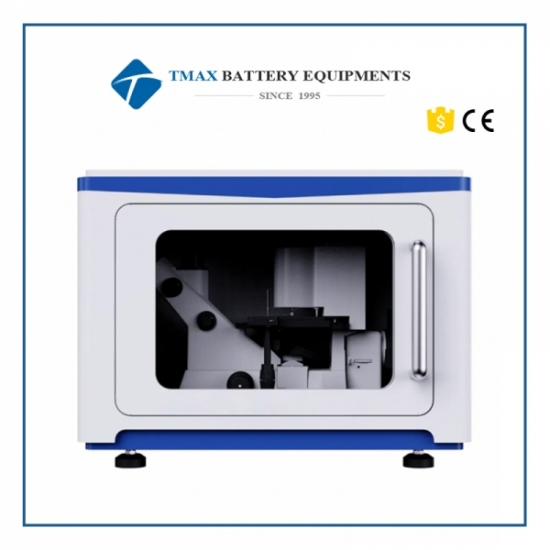
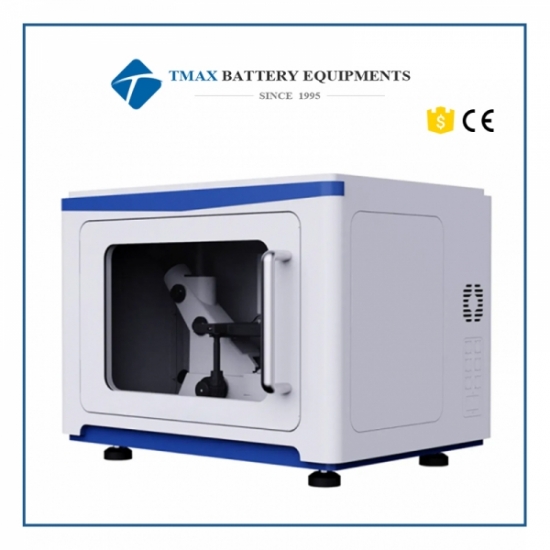
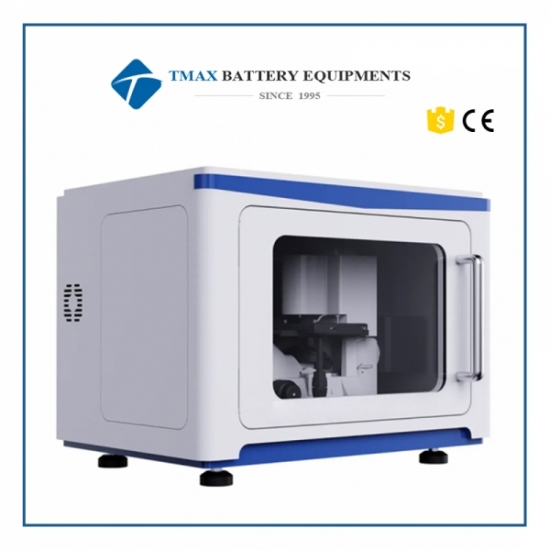
Single Particle Force Properties Test System
Model Number:
TMAX-SPFT2000Compliance:
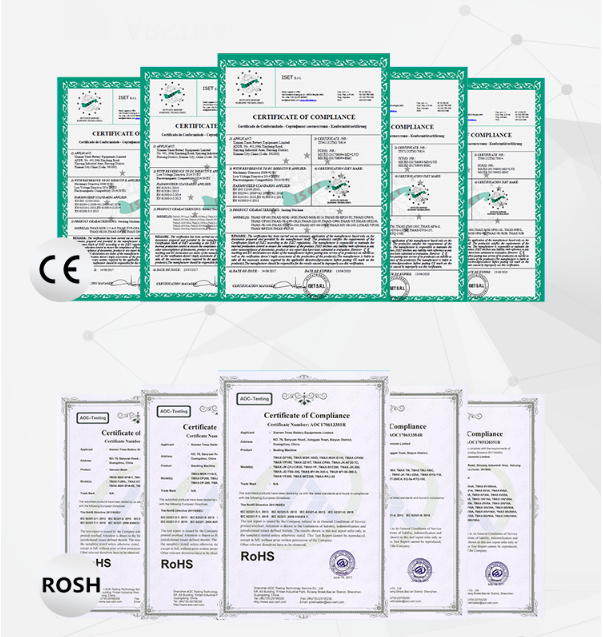
CE certificateWarranty:
Two Year Limited Warranty With Lifetime SupportPlace of Origin:
ChinaPayment:
T/T, Credit Card, Paypal, LC, Western UnionDelivery Time:
3 Days
Single Particle Force Properties Test System
Test Object
Lithium battery anode and cathode electrode materials
Test Particle Size
Single particle size: 5~50μm
Application
1. Testing the crushing strength of battery material particles
2. Can be used to evaluate the pressure resistance of the material
3. Guide the rolling process
4. Materials with high mechanical strength will have better subsequent cycle stability.
Product Introduction
1.Background
Testing the crushing strength of battery material particles can be used to evaluate the pressure resistance of the material and guide the rolling process. Materials with high mechanical strength will have better subsequent cycle stability.

2. Testing Object
Lithium battery positive and negative electrode materials(Positive: polycrystalline ternary; lithium-rich material; Negative: silicon-based, hard carbon, etc.; solid electrolyte)
3. Test Particle Size
Single particle size: 5~50 um
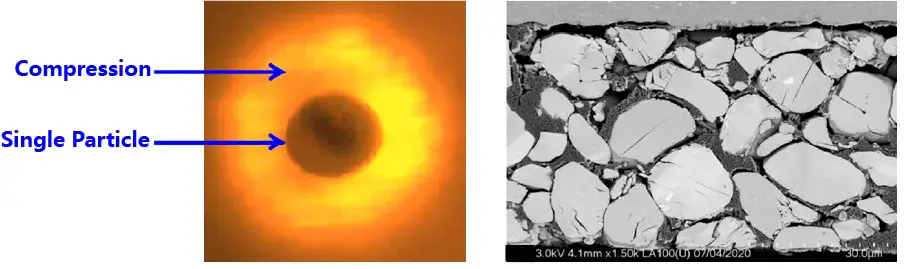
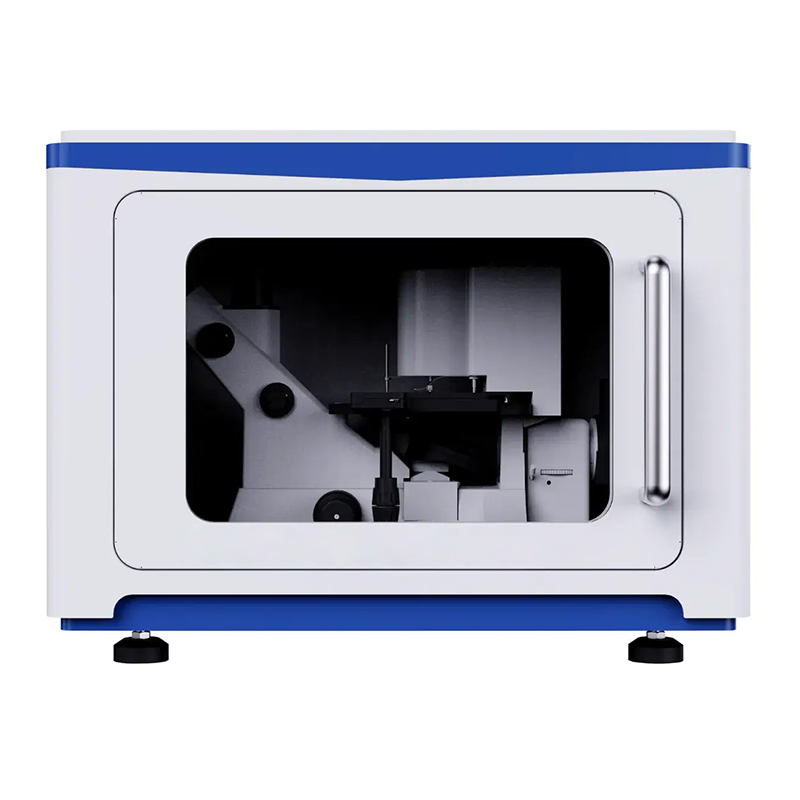
4. Equipment Composition

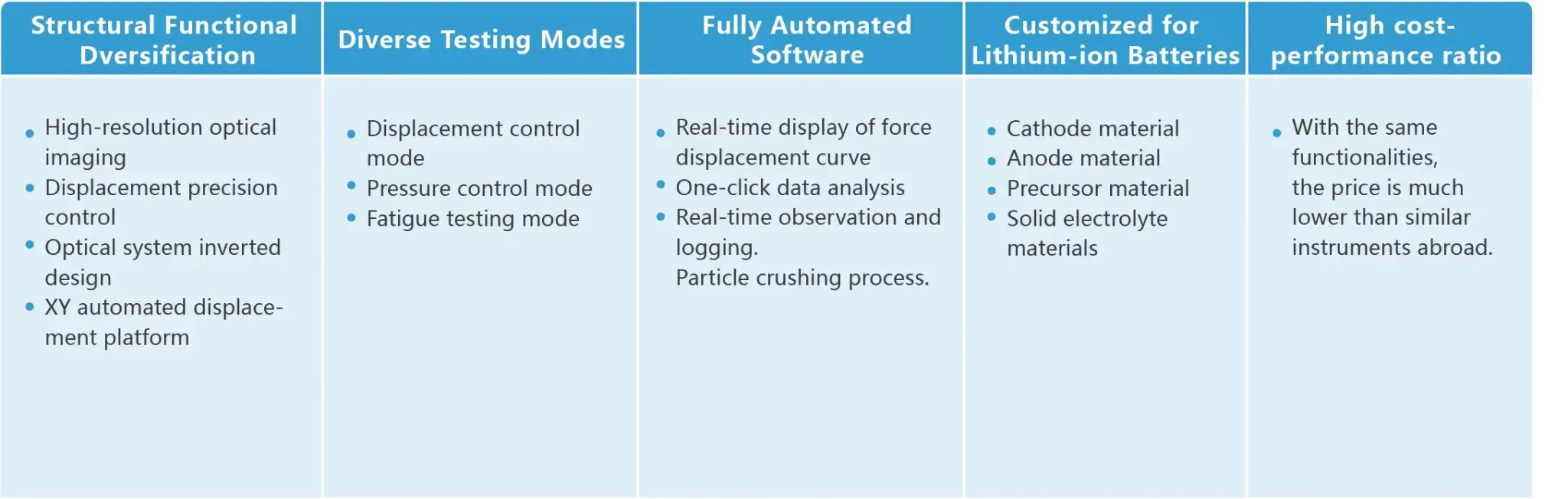
Testing Program
1. Testing Method
Disperse the powder into the liguid., Add it dropwise to the glass slide. Locate the single particle under an optical microscope. Control the pressure head to press down at a constant speed. Collect the force and displacement curves during the particle compression process and calculate the mechanical properties of the single particle.
1) Magnification: up to 1200 times;
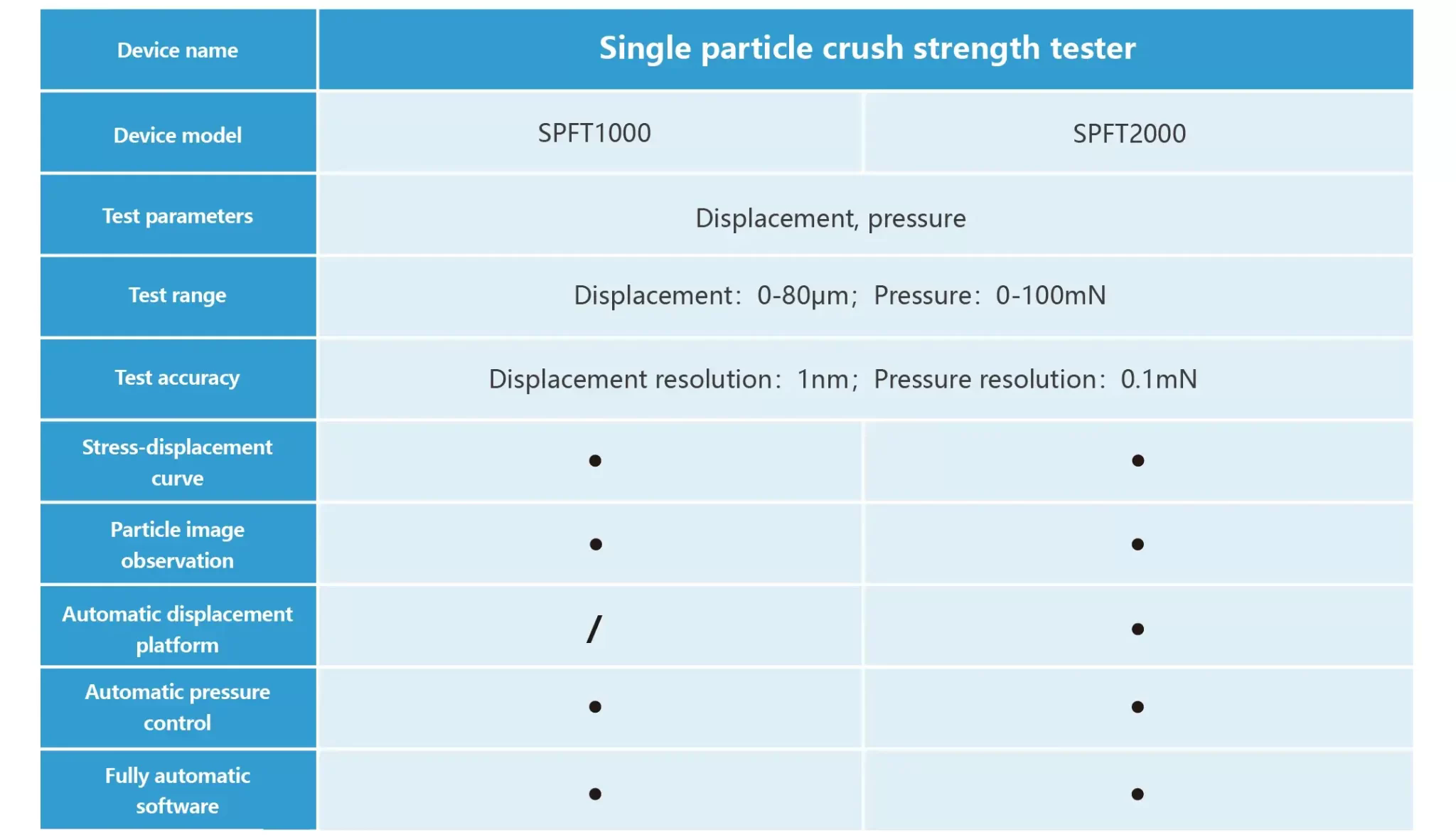
2) Pressure test range: 0-100 mN;
3) Pressure test accuracy: ±0.1 mN;
4) Minimum displacement unit: 10 nm;
5) Data collection frequency: 1000HZ.
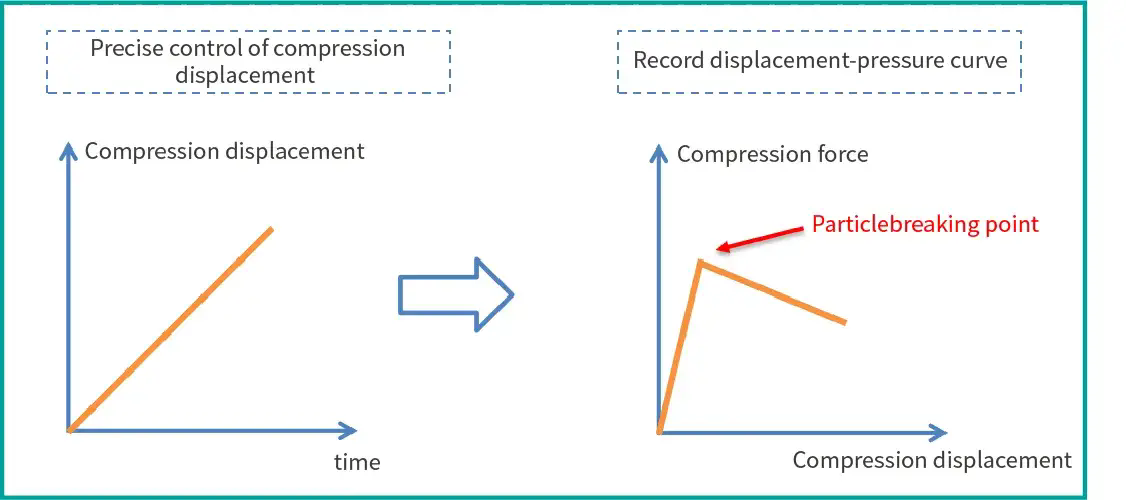
6) Comply with national standard GB/T 43091-2023″Powder Compressive strength Test Method”
Application Cases
1. Anode Material-Sic
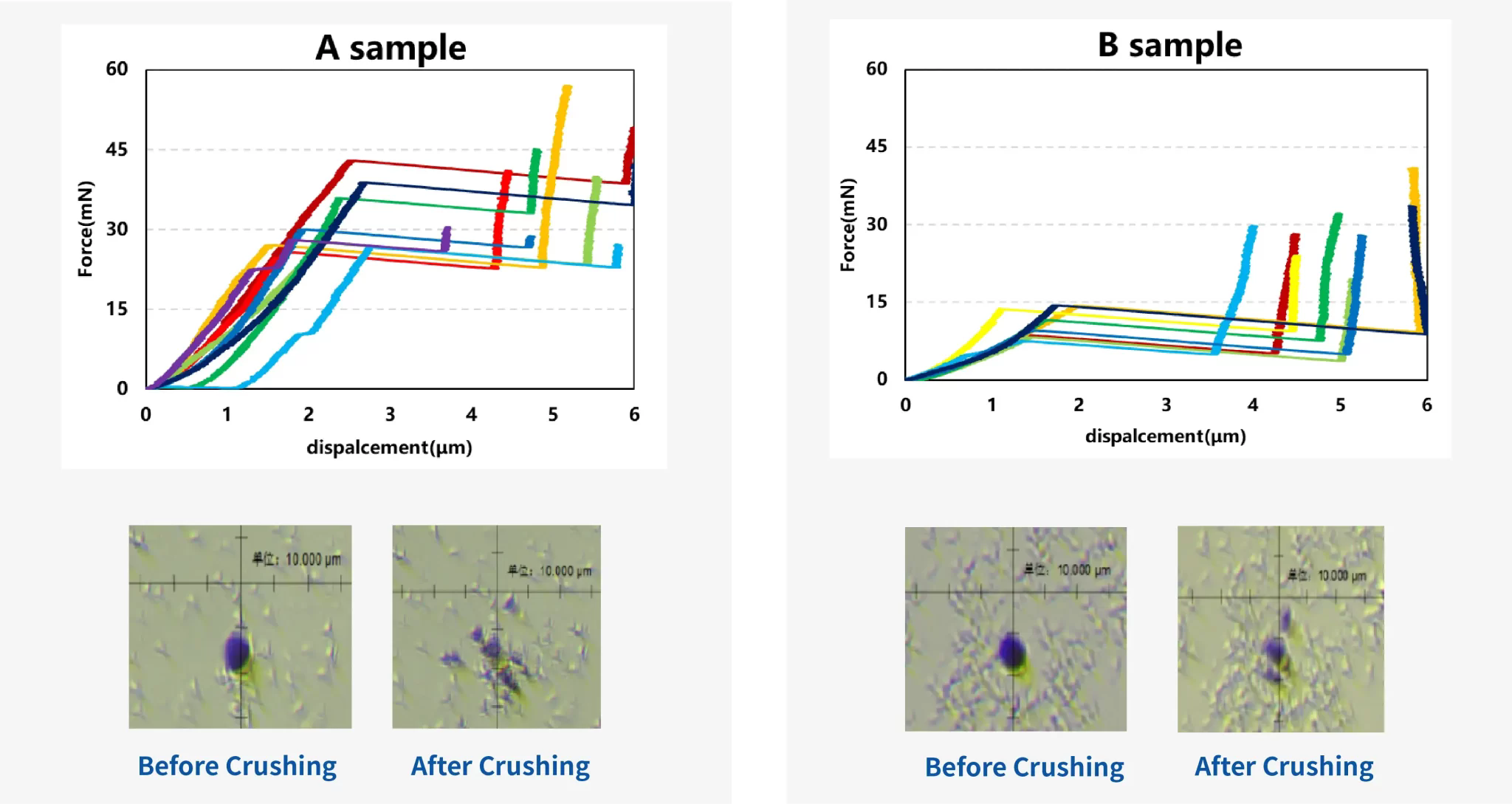
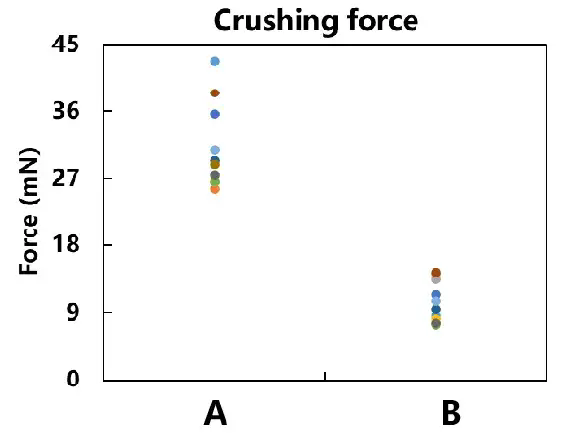
1) Two silicon-carbon materials with different electrode compaction.
2) Comparison of crushing force distribution: A>B.
3) Analysis of stress-displacement curves: Sample A exhibits initialmicro-crackingfollowed by complete collapse, while sample B expe-riences direct structural collapse and fragmentation.
4) Comparison of Disintegration States: after fracturing, all three groups disintegrate into fine granular states.
Particle Compression Resistance and Powder Compaction
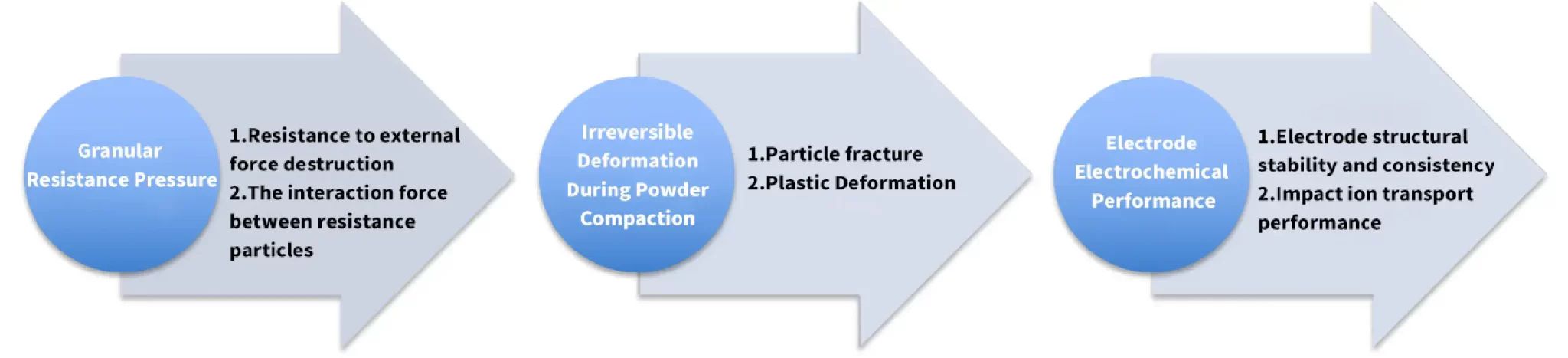
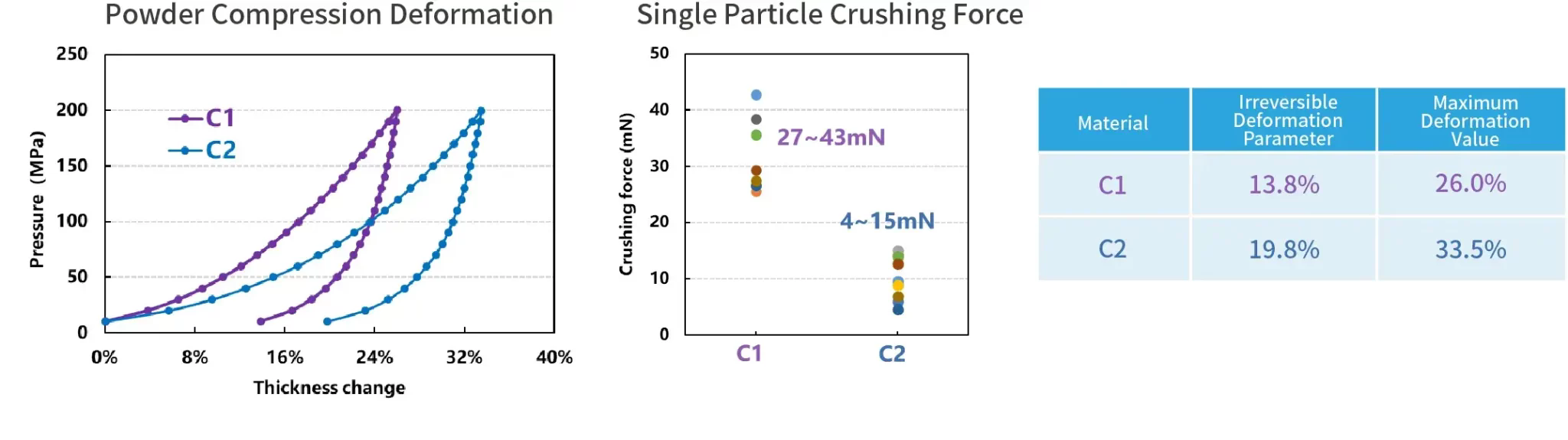
The compressive resistance of particle level C1 is stronger. Corresponding to the powder end, C1has a higher compression modulus than C2, with both maximum deformation and irreversible deformation smaller than C2.
Case 2: Three Different Carbon-Silicon Materials
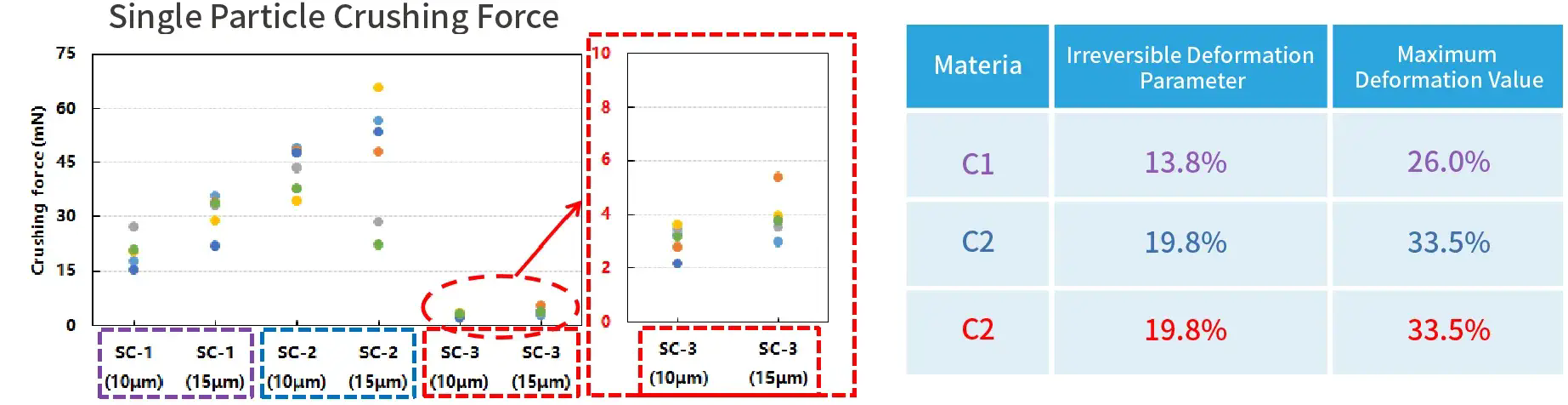
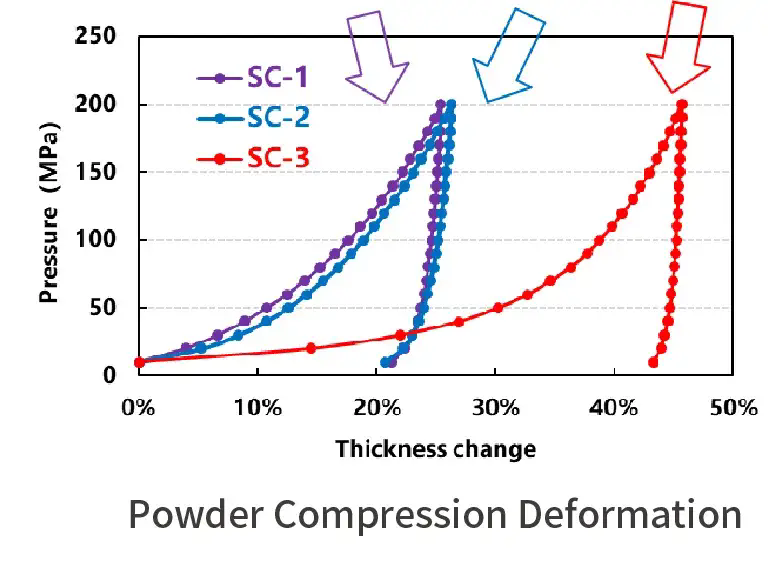
SC-3 has weaker compressive strength of its particles, resulting in significantly larger maximum deformation and irreversible deformation when the powder is compressed compared to theother two materials.
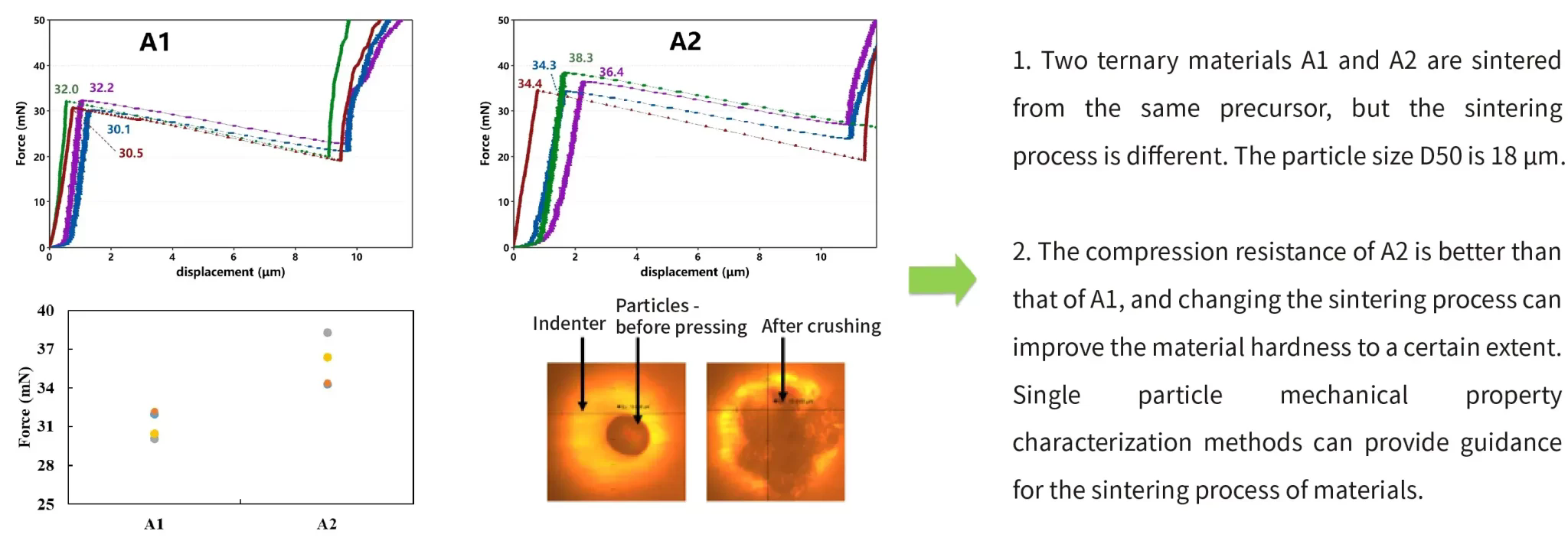
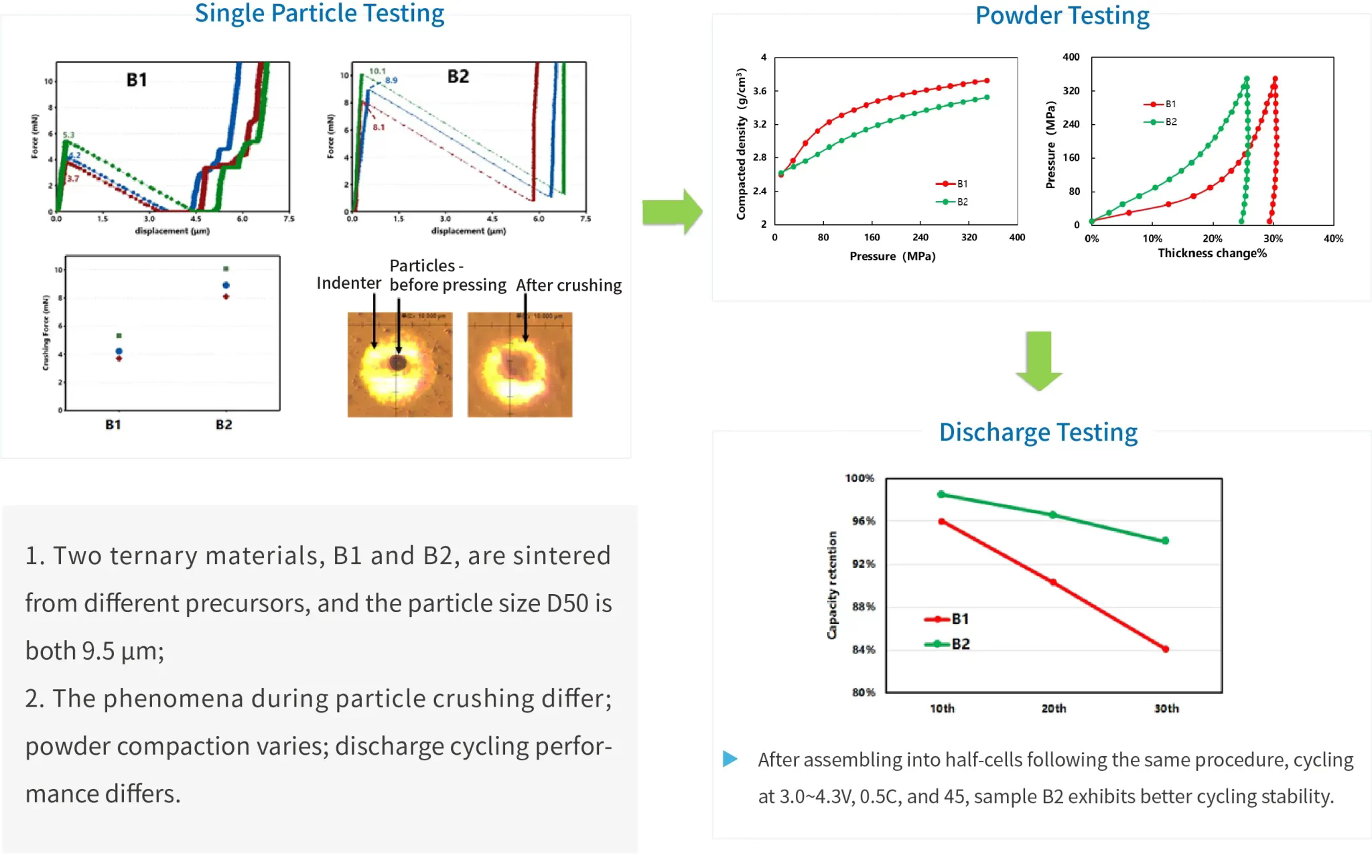
2. Ternary Cathode Material-NCM811
Specifications



 David@battery-equipments.com

