 English▼



- Battery Manufacturing Equipment
- Battery Laboratory Assembly Equipment
- Battery Pack Assembly Equipment
- Sodium Ion Battery Manufacturing Equipment
- Solid State Cell Production Line
- Dry Electrode Assembly Equipment
- Supercapacitor Assembly Equipment
- Perovskite Solar Cell Lab Equipment
- Li ion Battery Materials
- Ni / Al / Cu Metal Foam
- Customized Electrode
- Cathode Active Materials
- Anode Active Materials
- Coin Cell Parts
- Lithium Chip
- Cylindrical Cell Parts
- Battery Current Collectors
- Battery Conductive Materials
- Electrolyte
- Battery Binder
- Separator and Tape
- Aluminum Laminate Film
- Nickel Strip/Foil
- Battery Tabs
- Graphene Materials
- Cu / Al / Ni / Stainless steel Foil
- Battery Laboratory Equipment
- Li ion Battery Tester
- Battery Safety Tester
- Material Characterization Tester
- Rolling Press Machine
- Electrode Mixer
- Coin Cell Crimping Machine
- Coin Cell Electrode Disc Punching
- Pouch Cell Sealing Machine
- Pouch Cell Stacking Machine
- Pouch Cell Forming Machine
- Pouch Cell Ultrasonic Welder
- Pouch Cell Electrode Die Cutter
- Cylinder Cell Sealing Machine
- Cylinder Cell Grooving Machine
- Electrode Slitting Machine
- Cylinder Cell Winding Machine
- Cylinder Cell Spot Welding Machine
- Electrolyte Filling
- Type Test Cell
- Other Battery Making Machine
- NMP Solvent Treatment System
- Vacuum Glove Box
- Coating Machine
- Lab Furnaces
- Ball Mill
- Laboratory Press
- Laboratory Equipment
- Press Equipment
- 2026-03-20
Xiamen Tmax Battery Equipments Limited was set up as a manufacturer in 1995, dealing with lithium battery equipments, technology, etc. We have total manufacturing facilities of around 200000 square foot and more than 230 staff. Owning a group of experie-nced engineers and staffs, we can bring you not only reliable products and technology, but also excellent services and real value you will expect and enjoy.
Pouch Cell Assembly: Overview, Features, Manufacturing Process, Applications, Advantages, and Conclusion
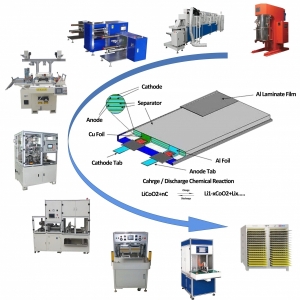
Pouch cell assembly is a critical process in the production of lithium-ion and other advanced battery types. Pouch cells, also known as lithium polymer cells, are compact, flexible, and lightweight energy storage units widely used in consumer electronics, electric vehicles, and energy storage systems. The assembly process involves stacking or winding electrode materials within a flexible aluminum-laminated pouch, adding electrolyte, and sealing the unit to create a high-performance battery with excellent energy density and safety characteristics.
Overview
Pouch cell assembly equipment is designed to automate or semi-automate the precise handling, alignment, and stacking or winding of electrodes and separators, as well as electrolyte filling and sealing. The flexible pouch design enables the production of batteries with varied shapes and capacities while reducing overall weight. High precision and cleanliness are essential in pouch cell assembly to ensure optimal battery performance, prevent contamination, and achieve consistent quality.
Key Features of Pouch Cell Assembly Equipment
Pouch cell assembly machines exhibit several critical features:
Precision Electrode Alignment: Accurate placement and stacking of anode, cathode, and separator layers.
Electrolyte Filling Control: Precise dispensing of electrolyte for optimal ion conductivity and minimal leakage.
Sealing Mechanism: Uniform heat or ultrasonic sealing of the flexible pouch to ensure airtight encapsulation.
Automation and Scalability: Supports batch or continuous production for laboratory, pilot, and industrial scales.
Cleanroom Compatibility: Reduces contamination risk and ensures high-quality battery performance.
Process Monitoring: Real-time inspection and quality control systems to detect defects and maintain consistency.
Manufacturing Process
The pouch cell assembly process typically involves the following steps:
Material Preparation: Electrodes (anode and cathode) and separators are cut or wound to precise dimensions.
Stacking or Winding: Electrodes and separators are stacked or rolled inside the pouch to form the core battery structure.
Electrolyte Filling: Controlled injection of electrolyte into the pouch ensures complete wetting of the electrodes.
Sealing: Heat or ultrasonic sealing methods are used to close the pouch, creating an airtight and mechanically stable battery unit.
Inspection and Testing: The assembled pouch cell is inspected for leakage, proper alignment, voltage, and initial capacity.
Advanced assembly lines may integrate automation, vacuum filling, and in-line quality control to enhance efficiency and reproducibility.
Pouch cells assembled using modern equipment are utilized in various sectors:
Consumer Electronics: Smartphones, tablets, laptops, and wearable devices.
Electric Vehicles (EVs): Battery packs for electric cars, bikes, and scooters.
Energy Storage Systems: Residential, commercial, and grid-scale storage solutions.
Medical Devices: Portable healthcare equipment requiring lightweight and flexible batteries.
Research and Development: Prototype and experimental battery assembly for performance testing.
Advantages
The primary advantages of automated pouch cell assembly include:
High Precision and Reproducibility: Ensures consistent battery performance and reliability.
Lightweight and Flexible Design: Enables compact and versatile battery formats.
Enhanced Safety: Airtight sealing and precise electrolyte control reduce leakage and short-circuit risks.
Efficiency and Scalability: Supports both small-scale R&D and large-scale industrial production.
Quality Control: Integrated monitoring systems maintain high-quality standards and reduce defects.
Material Optimization: Minimizes waste and ensures uniform use of electrodes and electrolyte.
Conclusion
In conclusion, pouch cell assembly is a crucial process in modern battery manufacturing, enabling the production of high-performance, flexible, and lightweight energy storage units. Advanced assembly equipment ensures precise electrode placement, uniform electrolyte distribution, and reliable sealing, resulting in safe, durable, and efficient batteries. Widely applied in consumer electronics, electric vehicles, energy storage, and medical devices, pouch cells assembled with modern equipment provide high energy density, mechanical flexibility, and consistent quality. With scalable automation and rigorous quality control, pouch cell assembly technology continues to drive innovation and efficiency in the energy storage industry.
-
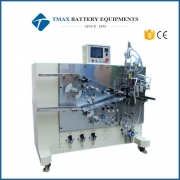 Automatic Cylinderical Battery Electrode Winding Machine
Read More
Automatic Cylinderical Battery Electrode Winding Machine
Read More
-
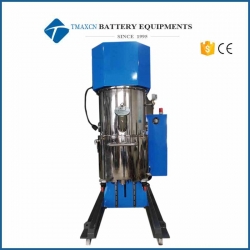 100-200L Double Planetary Vacuum Mixing Machine for Lithium Battery Slurry
Read More
100-200L Double Planetary Vacuum Mixing Machine for Lithium Battery Slurry
Read More
-
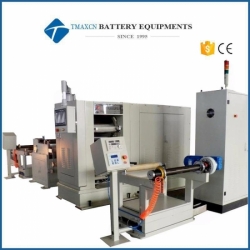 Large Heating Roller Press Machine Calender For Li ion Battery Production Line
Read More
Large Heating Roller Press Machine Calender For Li ion Battery Production Line
Read More
-
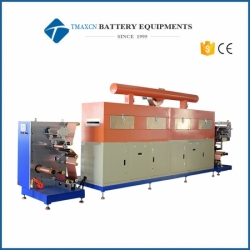 Large 3 Rollers Battery Electrode Film Intermittent Coating Machine for Pilot Production Line
Read More
Large 3 Rollers Battery Electrode Film Intermittent Coating Machine for Pilot Production Line
Read More
-
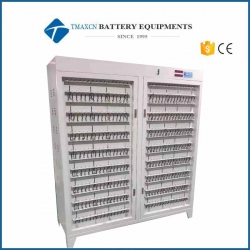 512 Channel 5V3A Battery Grading Machine/Battery Charge Discharge Machine Tester
Read More
512 Channel 5V3A Battery Grading Machine/Battery Charge Discharge Machine Tester
Read More
 David@battery-equipments.com

