 English▼



- Battery Manufacturing Equipment
- Battery Laboratory Assembly Equipment
- Battery Pack Assembly Equipment
- Sodium Ion Battery Manufacturing Equipment
- Solid State Cell Production Line
- Dry Electrode Assembly Equipment
- Supercapacitor Assembly Equipment
- Perovskite Solar Cell Lab Equipment
- Li ion Battery Materials
- Ni / Al / Cu Metal Foam
- Customized Electrode
- Cathode Active Materials
- Anode Active Materials
- Coin Cell Parts
- Lithium Chip
- Cylindrical Cell Parts
- Battery Current Collectors
- Battery Conductive Materials
- Electrolyte
- Battery Binder
- Separator and Tape
- Aluminum Laminate Film
- Nickel Strip/Foil
- Battery Tabs
- Graphene Materials
- Cu / Al / Ni / Stainless steel Foil
- Battery Laboratory Equipment
- Li ion Battery Tester
- Battery Safety Tester
- Material Characterization Tester
- Rolling Press Machine
- Electrode Mixer
- Coin Cell Crimping Machine
- Coin Cell Electrode Disc Punching
- Pouch Cell Sealing Machine
- Pouch Cell Stacking Machine
- Pouch Cell Forming Machine
- Pouch Cell Ultrasonic Welder
- Pouch Cell Electrode Die Cutter
- Cylinder Cell Sealing Machine
- Cylinder Cell Grooving Machine
- Electrode Slitting Machine
- Cylinder Cell Winding Machine
- Cylinder Cell Spot Welding Machine
- Electrolyte Filling
- Type Test Cell
- Other Battery Making Machine
- NMP Solvent Treatment System
- Vacuum Glove Box
- Coating Machine
- Lab Furnaces
- Ball Mill
- Laboratory Press
- Laboratory Equipment
- Press Equipment
- 2026-02-27
Xiamen Tmax Battery Equipments Limited was set up as a manufacturer in 1995, dealing with lithium battery equipments, technology, etc. We have total manufacturing facilities of around 200000 square foot and more than 230 staff. Owning a group of experie-nced engineers and staffs, we can bring you not only reliable products and technology, but also excellent services and real value you will expect and enjoy.
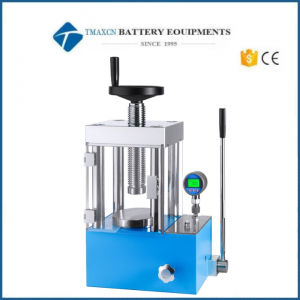
Hydraulic Press: Overview, Features, Manufacturing Process, Applications, Advantages, and Conclusion
A hydraulic press is a powerful mechanical device that uses hydraulic cylinders to generate compressive force for a wide range of industrial applications. By leveraging the principles of hydraulics, these presses are capable of exerting enormous pressure with precise control, making them indispensable in metal forming, material testing, molding, and assembly processes. Hydraulic presses are valued for their efficiency, adaptability, and reliability across various manufacturing sectors.
Overview
Hydraulic presses operate based on Pascal’s Law, which states that pressure applied to a confined fluid is transmitted uniformly in all directions. The press consists of a hydraulic pump, cylinder, piston, and a frame that supports the material being processed. When hydraulic fluid is pumped into the cylinder, the piston moves, generating high compressive force on the workpiece. Unlike mechanical presses, hydraulic presses provide consistent pressure throughout the stroke and allow adjustable force, stroke length, and speed, enhancing flexibility in manufacturing processes.
Key Features of Hydraulic Presses
Hydraulic presses are distinguished by several important features:
High Force Generation: Capable of delivering pressures from a few tons to several thousand tons.
Adjustable Pressure and Stroke: Provides precise control over pressing operations.
Uniform Pressure Distribution: Ensures consistent material deformation and reduces defects.
Versatility: Suitable for forming, bending, punching, deep drawing, and forging operations.
Durable Construction: Heavy-duty frames and cylinders support long-term operation.
Automation Compatibility: Can be integrated with CNC systems for enhanced productivity and repeatability.
Manufacturing Process
The hydraulic press manufacturing and operational process involve several key steps:
Frame Fabrication: Heavy-duty steel frames are machined and assembled to withstand high pressures.
Cylinder and Piston Installation: Precision hydraulic cylinders and pistons are mounted to generate and transfer force.
Hydraulic System Integration: Pumps, valves, and fluid reservoirs are installed to control pressure, flow, and movement.
Control System Setup: Manual or digital controllers are integrated to regulate pressure, stroke length, and operational sequences.
Testing and Calibration: Each press is tested for pressure accuracy, stroke control, and safety compliance before deployment.
Advanced hydraulic presses may incorporate sensors, programmable logic controllers (PLC), and automation systems for precise and repeatable operations.
Applications
Hydraulic presses are extensively used in various industries due to their strength and versatility:
Metal Forming: Bending, punching, deep drawing, and forging of metal sheets and components.
Automotive Industry: Manufacturing car body panels, engine parts, and chassis components.
Aerospace Industry: Forming high-strength alloys for aircraft components.
Plastic and Composite Molding: Compression molding of plastics, rubber, and composite materials.
Material Testing: Conducting compressive strength tests and durability assessments.
Assembly Operations: Press-fitting bearings, bushings, and other precision components.
Advantages
Hydraulic presses offer several notable advantages:
High Precision and Control: Adjustable force and stroke provide consistent and accurate results.
Versatility: Capable of handling a wide range of materials and operations.
Energy Efficiency: Modern hydraulic systems optimize power consumption while delivering high force.
Durable and Reliable: Robust construction ensures long operational life and minimal downtime.
Scalability: Available in small, medium, and large capacities to suit various industrial needs.
Automation Integration: Enhances productivity, repeatability, and safety in modern manufacturing setups.
Conclusion
In conclusion, the hydraulic press is a versatile and essential mechanical device for industrial manufacturing and material processing. Its ability to deliver high compressive force with precision, adjustable control, and uniform pressure makes it ideal for metal forming, molding, assembly, and testing applications. With durable construction, automation compatibility, and energy-efficient operation, hydraulic presses provide reliable, flexible, and efficient solutions across automotive, aerospace, plastics, and general manufacturing industries. As production demands increase and processes become more complex, hydraulic presses continue to play a critical role in modern manufacturing, enabling high-quality output and operational efficiency.
-
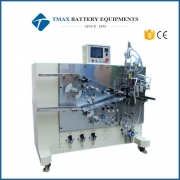 Automatic Cylinderical Battery Electrode Winding Machine
Read More
Automatic Cylinderical Battery Electrode Winding Machine
Read More
-
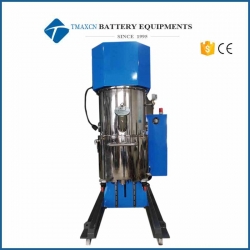 100-200L Double Planetary Vacuum Mixing Machine for Lithium Battery Slurry
Read More
100-200L Double Planetary Vacuum Mixing Machine for Lithium Battery Slurry
Read More
-
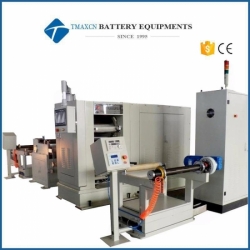 Large Heating Roller Press Machine Calender For Li ion Battery Production Line
Read More
Large Heating Roller Press Machine Calender For Li ion Battery Production Line
Read More
-
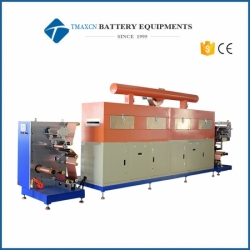 Large 3 Rollers Battery Electrode Film Intermittent Coating Machine for Pilot Production Line
Read More
Large 3 Rollers Battery Electrode Film Intermittent Coating Machine for Pilot Production Line
Read More
-
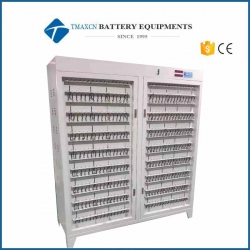 512 Channel 5V3A Battery Grading Machine/Battery Charge Discharge Machine Tester
Read More
512 Channel 5V3A Battery Grading Machine/Battery Charge Discharge Machine Tester
Read More
 David@battery-equipments.com

